

A peptide Certificate of Analysis, usually shortened to COA, should do more than make a product page look official. For a research lab, the COA is the batch-level record that connects a vial, a lot number, and a test result. When it is easy to find and easy to compare with the product label, it helps researchers avoid uncertainty before checkout.
This guide is for controlled laboratory research review only.
Start with the batch identity
The first thing to check is whether the document clearly identifies the product and batch. A useful COA should show the compound name, lot or batch number, test date, and issuing laboratory. If the batch number on the document cannot be matched to the item being ordered, the document is much less useful because it cannot be traced back to the specific material.
Look for the method, not only the number
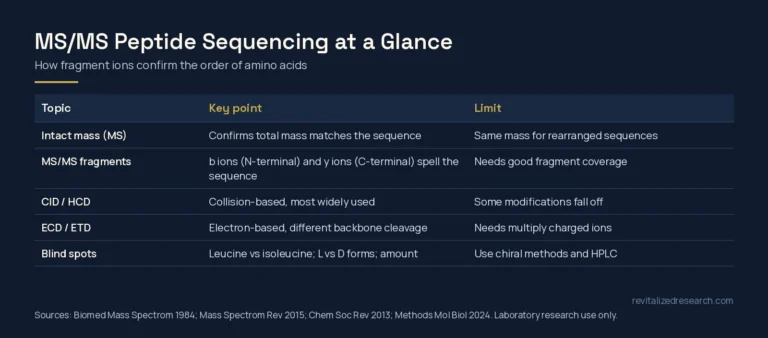
A purity percentage is only meaningful when the analytical method is stated. Peptide purity is commonly evaluated using chromatography, while identity is commonly supported with mass spectrometry. These methods answer different questions: chromatography helps separate the main compound from related impurities, while mass spectrometry helps confirm molecular identity.
A stronger COA will show the testing method, a chromatogram or report page, the result, and the laboratory name. A weaker document may show a large purity number without method details, date, batch number, or any way to verify the report.
Check the lab and document consistency
Good documentation is consistent. Product names should be spelled the same way, dates should make sense, and the batch number should match any product-page documentation or QR/reference system. If a report has a QR code, lab portal link, or report identifier, use it to confirm that the PDF is connected to a real report.
What a COA cannot tell you
A COA is a quality-control document for the tested batch. Researchers should still review storage conditions, handling requirements, institutional protocols, and whether additional documentation is needed for the intended laboratory workflow.
Quick checklist
- Product name is present and matches the listing.
- Batch or lot number is clear.
- Purity result includes the analytical method.
- Identity confirmation is included when available.
- Testing lab, report date, and document source are visible.
- The report is connected to the exact product or variant being ordered.
Research-use reminder: Revitalized Research products are supplied for controlled laboratory research use only.