

Peptide testing language can look simple on a product page: a purity percentage, a batch number, and a PDF link. Underneath that simple presentation, chromatography and mass spectrometry often play different roles. Understanding the difference helps researchers read COAs with a more critical eye.
This article is for laboratory research education only.
HPLC separates what is in the sample
High-performance liquid chromatography, or HPLC, is commonly used to separate a peptide sample into detectable peaks. In a simplified reading, the main peak is associated with the target material, while smaller peaks can indicate related impurities or process by-products.
That is why a purity result should be connected to a chromatogram or method. A single percentage without the method, report date, and batch link does not tell the full story. Peak shape, baseline behavior, and separation quality all matter when reviewing whether the result is informative.
Mass spectrometry helps confirm identity
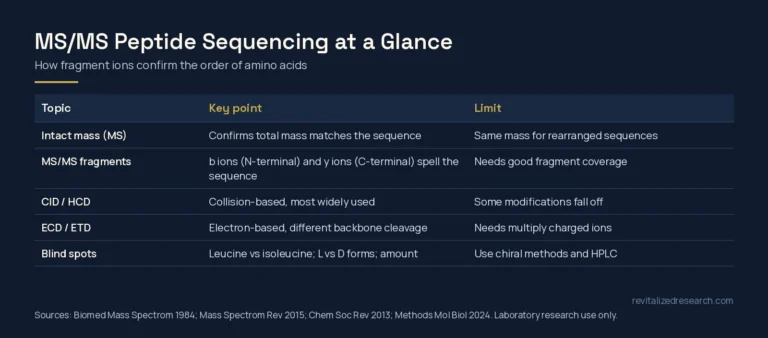
Mass spectrometry, often abbreviated MS, provides molecular-weight information that can support identity confirmation. In peptide analysis, MS can help show whether the material being measured aligns with the expected compound. It is especially useful because closely related peptide impurities can be difficult to evaluate by chromatography alone.
For a stronger quality-control picture, HPLC and MS are complementary. HPLC helps answer, “How much of the detectable material is associated with the main peak?” MS helps answer, “Does the detected material match the expected molecule?”
Why method transparency matters
Transparent COAs should make the analytical basis visible. Researchers should look for the test date, method name, batch number, laboratory identity, and report pages that support the result. More advanced reports may include LC-MS or other coupled methods where chromatography and mass-based detection are used together.
What to compare across products
- Does each product or variant have batch-specific documentation?
- Is the stated purity tied to an analytical method?
- Is identity confirmation included or referenced?
- Does the COA date align with the current batch?
- Can the laboratory or report source be verified?
Research-use reminder: Testing documentation supports laboratory material review.