
Some impurities in a synthetic peptide come from a step that simply did not finish, like a missed coupling. Others come from a side reaction, where the chemistry does something unintended to a residue that is already in place. Aspartimide formation is one of the best known of these. It affects sequences that contain aspartic acid, and its by-products include peptides with exactly the same mass as the target. This guide explains how it happens and how chemists keep it in check.
What an aspartimide is
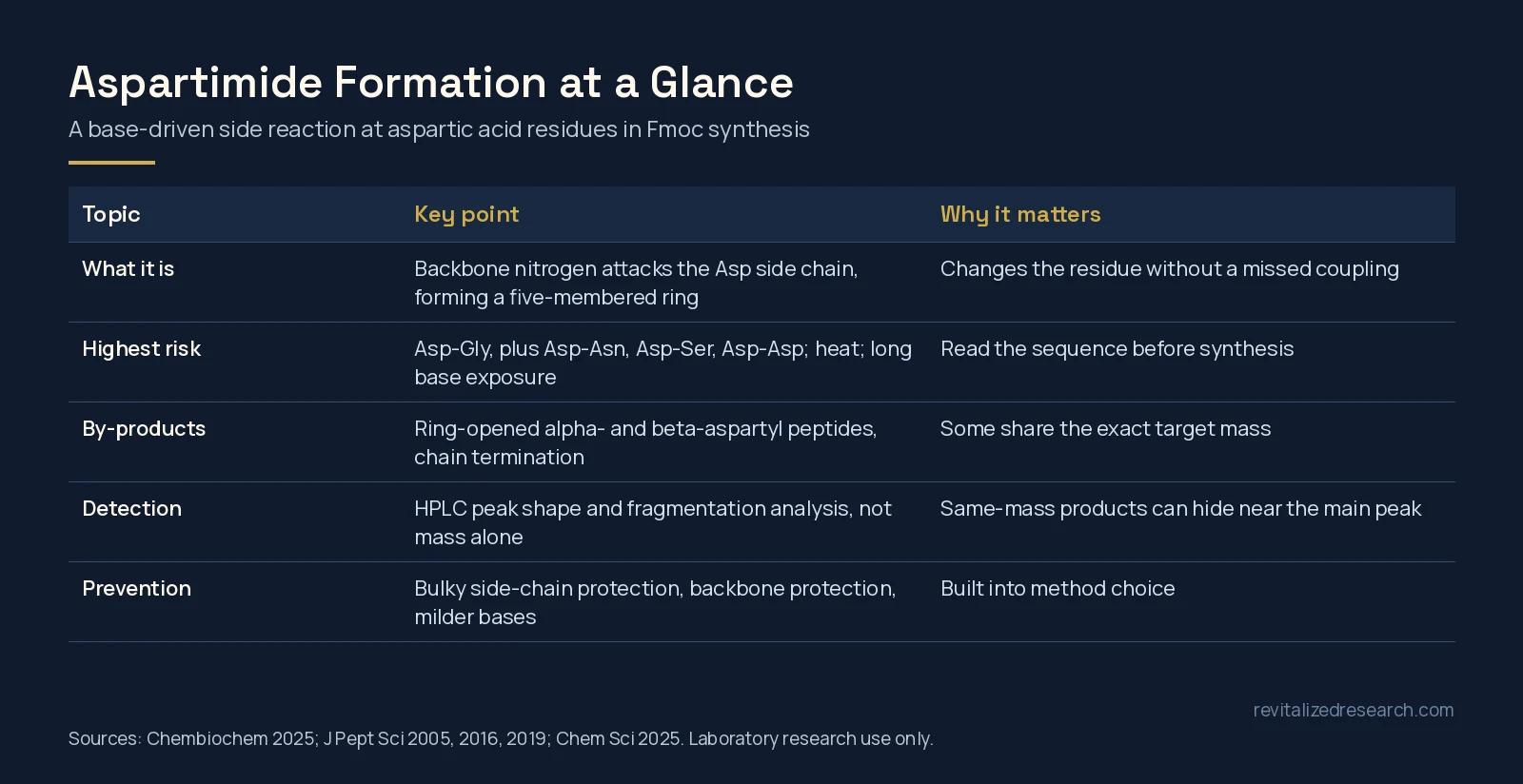
An aspartimide is a five-membered ring that forms when the backbone nitrogen of the next residue attacks the side chain of an aspartic acid (or asparagine) residue [1]. In Fmoc solid-phase synthesis, the basic conditions used to remove the Fmoc group at every cycle drive this reaction, which is why it is described as base-mediated aspartimide formation [2]. It has also been shown to occur under acidic conditions, and the extent depends on the side-chain protecting group, the acid or base used and the peptide sequence [3].
The longer a sequence is exposed to base, the more chances the reaction has. An aspartic acid residue near the start of a long peptide sees every later deprotection step, which is one reason aspartimide is a bigger concern for longer sequences.
Which sequences are most at risk
The residue after the aspartic acid matters a great deal. The Asp-Gly motif is the classic problem case: the short model peptide VKDGYI is widely used to test how well a method suppresses aspartimide formation during extended piperidine exposure [4]. Heat also raises the risk. In microwave-enhanced Fmoc synthesis, aspartimide formation and racemization can both occur but can be controlled with optimized methods [5]; the racemization side of that study is covered in our guide to peptide racemization and chiral purity.
When reading a sequence, chemists look for aspartic acid followed by glycine, asparagine, serine or another aspartic acid. The BPC-157 sequence, for example, contains two adjacent aspartic acid residues, so a synthesis method for that sequence has to take this side reaction into account.
The by-products it creates
The aspartimide ring itself is only the start. When the ring is opened by water, for example during HPLC purification, it gives a mixture of alpha- and beta-aspartyl peptides that cannot be purified easily [3]. The beta-aspartyl form has the same atoms as the target but a rearranged backbone. Other side products are possible too: one group observed significant chain termination when synthesizing an N-terminal Xaa-Asp-Yaa motif, caused by piperazine-2,5-dione formation from the aspartimide intermediate [6].
The key problem for quality control is that several of these products have the same molecular mass as the intended peptide. A study of chemical protein synthesis reported that aspartimide-related side reactions may have been overlooked because they are hard to identify with standard HPLC methods and because the aspartimide converts into other by-products with the same mass as the parent aspartate residue [1]. A matching mass on a certificate of analysis therefore does not prove aspartimide products are absent, the same point our HPLC vs mass spectrometry guide makes about other same-mass impurities.
| Product | Mass vs target | How it is usually spotted |
|---|---|---|
| Aspartimide (ring intact) | 18 Da lighter (loss of water) | Mass spectrometry, separate HPLC peak |
| Beta-aspartyl peptide | Same mass | HPLC peak near the main peak; fragmentation analysis |
| Epimerized (D-Asp) forms | Same mass | Chiral or high-resolution HPLC methods |
| Piperazine-2,5-dione (chain termination) | Truncated sequence | Mass spectrometry, HPLC |
How chemists limit it
Because the reaction is built into Fmoc chemistry, it has its own toolbox of countermeasures. A 2025 review groups them into bulky ester protecting groups on the aspartic acid side chain, non-ester masking groups, backbone-protecting groups, and alternatives to Fmoc that are removed under non-basic conditions [2].
- Bulkier side-chain protection. New trialkylmethyl ester protected aspartic acid building blocks were tested on the VKDGYI model and compared with the common approach of adding acids to the deprotection solution [4].
- Different side-chain masking. Cyanosulfurylides mask the carboxylic acid with a stable carbon-carbon bond and have been used to make a range of peptides and proteins that are otherwise hard to access because of aspartimide formation [7].
- Backbone protection. A backbone amide protecting group (Hmnb) improved the synthesis of aggregation- and aspartimide-prone peptides [8].
- Milder deprotection bases. Dipropylamine strongly reduced aspartimide formation compared with piperidine in high-temperature (60 °C) solid-phase synthesis [9].
What this means when you read a COA
For aspartic acid-containing sequences, a high HPLC purity backed by a clean mass spectrum is the right starting point, but it helps to know that some aspartimide products can sit very close to the main peak. Good documentation names the methods used and shows the chromatogram. Our guide to synthetic peptide impurities places aspartimide alongside the other common by-products, and every Revitalized Research batch document is in our COA library.
All Revitalized Research products are sold for laboratory research use only. They are not for human or veterinary use. This article describes analytical chemistry and does not make any claim about biological effects.
Frequently asked questions
What is aspartimide formation?
It is a side reaction in peptide synthesis where the backbone nitrogen after an aspartic acid residue attacks that residue’s side chain and forms a five-membered ring. In Fmoc synthesis it is mainly driven by the basic conditions used to remove the Fmoc group.
Which peptide sequences are most prone to aspartimide formation?
Sequences where aspartic acid is followed by glycine are the classic problem case, and other partners such as asparagine, serine or a second aspartic acid also raise the risk. Higher temperatures and long exposure to base increase it further.
Why can aspartimide by-products be missed?
After the ring opens, it can form beta-aspartyl and other products with the same mass as the target peptide. These can elute close to the main HPLC peak, so a matching mass alone does not rule them out.
How do chemists reduce aspartimide formation?
Common approaches include bulkier protecting groups on the aspartic acid side chain, non-ester masking groups, backbone amide protection, milder deprotection bases such as dipropylamine, and adding acid to the deprotection solution.
Does aspartimide formation happen with asparagine too?
Yes. The same five-membered ring can form from asparagine residues, which is one reason it is discussed together with deamidation in peptide stability work.
References
- Cisse EH, Aucagne V (2025). Identification, occurrence and prevention of aspartimide-related byproducts in chemical protein synthesis. Chem Sci. PMID: 40671757. doi: 10.1039/d5sc03824c.
- Kong MJW, van den Braak TJHP, Neumann K (2025). Aspartimide Formation and Its Prevention in Fmoc Chemistry Solid Phase Peptide Synthesis. Chembiochem. PMID: 40857621. doi: 10.1002/cbic.202500490.
- Stathopoulos P, Papas S, Kostidis S et al. (2005). Alpha- and beta- aspartyl peptide ester formation via aspartimide ring opening. J Pept Sci. PMID: 15884102. doi: 10.1002/psc.675.
- Behrendt R, Huber S, White P (2016). Preventing aspartimide formation in Fmoc SPPS of Asp-Gly containing peptides–practical aspects of new trialkylcarbinol based protecting groups. J Pept Sci. PMID: 26751703. doi: 10.1002/psc.2844.
- Palasek SA, Cox ZJ, Collins JM (2007). Limiting racemization and aspartimide formation in microwave-enhanced Fmoc solid phase peptide synthesis. J Pept Sci. PMID: 17121420. doi: 10.1002/psc.804.
- Samson D, Rentsch D, Minuth M et al. (2019). The aspartimide problem persists: Fluorenylmethyloxycarbonyl-solid-phase peptide synthesis (Fmoc-SPPS) chain termination due to formation of N-terminal piperazine-2,5-diones. J Pept Sci. PMID: 31309675. doi: 10.1002/psc.3193.
- Neumann K, Farnung J, Baldauf S et al. (2020). Prevention of aspartimide formation during peptide synthesis using cyanosulfurylides as carboxylic acid-protecting groups. Nat Commun. PMID: 32080186. doi: 10.1038/s41467-020-14755-6.
- Abdel-Aal AB, Papageorgiou G, Raz R et al. (2016). A backbone amide protecting group for overcoming difficult sequences and suppressing aspartimide formation. J Pept Sci. PMID: 27086749. doi: 10.1002/psc.2877.
- Personne H, Siriwardena TN, Javor S et al. (2023). Dipropylamine for 9-Fluorenylmethyloxycarbonyl (Fmoc) Deprotection with Reduced Aspartimide Formation in Solid-Phase Peptide Synthesis. ACS Omega. PMID: 36777595. doi: 10.1021/acsomega.2c07861.