
Amino acids come in two mirror-image forms, L and D. Natural peptides are built almost entirely from L-amino acids, and synthetic peptides are designed with a specific form at every position. During synthesis, a small fraction of a residue can flip to the opposite form. This is racemization, and the result is a diastereomer: a peptide with the right sequence and the right mass, but one wrong stereocenter. This guide explains how it happens, which residues are most at risk, and how chiral purity is measured.
How racemization happens during synthesis
In solid-phase synthesis, each amino acid is chemically activated so it can couple to the growing chain. Activation makes the hydrogen on the alpha-carbon easier to remove, and if it is removed and put back from the other side, the residue’s configuration flips. A review of peptide-related impurities lists racemization-derived diastereomers among the common synthesis by-products in Fmoc chemistry [1], alongside the deletion and insertion sequences covered in our guide to synthetic peptide impurities.
Because the problem is built into the chemistry, it is an active research area. One recent approach uses a thiol-removable amino protecting group in place of Fmoc and reported that it greatly suppressed alpha-carbon racemization and aspartimide formation compared with conventional synthesis [2].
Which residues are most at risk
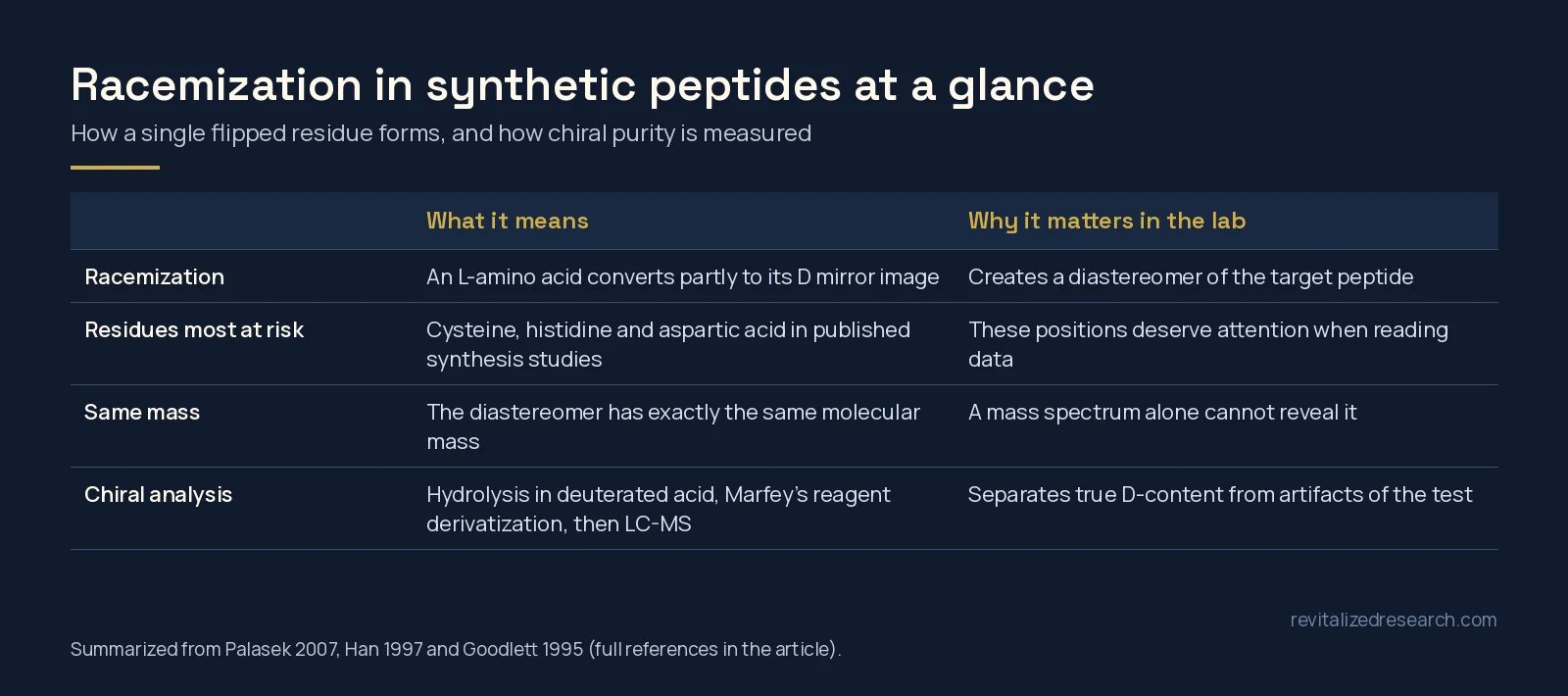
Not every amino acid racemizes equally. In a model 20-residue peptide containing all 20 natural amino acids and made with microwave-assisted Fmoc synthesis, cysteine, histidine and aspartic acid were the residues susceptible to racemization. Lowering the microwave coupling temperature from 80 °C to 50 °C limited racemization of histidine and cysteine, and coupling those two residues conventionally while making the rest of the chain with microwave heating also worked [3].
Cysteine is a known special case. Contrary to earlier assumptions, protected cysteine derivatives were shown to undergo substantial racemization with widely used coupling reagents and protocols. The study measured this with a simple model, separating H-Gly-L-Cys-Phe-NH2 from H-Gly-D-Cys-Phe-NH2 by HPLC, and compared coupling conditions and thiol protecting groups [4].
When a D-residue is there on purpose
Not every D-amino acid is an impurity. Some research peptides are designed with D-residues at chosen positions. In one study, partial D-amino acid substitution of an epitope peptide improved its stability against enzymes while keeping antibody recognition [5]. For a designed sequence like that, chiral purity means “the intended form at every position”, not “all L”. The specification on the documentation should always be read against the intended sequence.
Why mass spectrometry alone cannot see it
A diastereomer has exactly the same molecular formula and mass as the target peptide, so a matching mass on a COA does not rule racemization out. Reversed-phase HPLC can sometimes separate a diastereomer as a nearby peak, as in the cysteine model above [4], but whether it does depends on the sequence and conditions. Our HPLC vs mass spectrometry guide covers what each method can and cannot tell apart.
How chiral purity is measured
Hydrolysis, derivatization and LC-MS
The classic approach breaks the peptide into its amino acids and then measures the D and L forms of each one. A widely cited method hydrolyzes the peptide in deuterated acid, derivatizes the amino acids with Marfey’s reagent (FDAA) to turn D/L pairs into separable diastereomers, and resolves them by reversed-phase LC with electrospray mass spectrometry [6].
Why the acid is deuterated
Acid hydrolysis itself causes some racemization, which would make a sample look less pure than it is. Hydrolyzing in deuterated acid labels any residue that racemizes during the test with one deuterium at the alpha-carbon, which adds about 1 Da, so test-generated D-forms can be told apart from D-forms that were already in the peptide [6]. The same principle has been used with deuterated hydrochloric acid to distinguish innate D-amino acids in model peptides from those created during hydrolysis [7].
The derivatizing reagent
Marfey’s reagent has been reviewed in detail, including its use for D/L amino acids, cysteine residues in peptides and the study of racemization [8]. Method details matter: in one LC-MS/MS study, standard formic acid (pH 2) separations could not resolve all 19 common amino acid D/L pairs, while a water, acetonitrile and ammonium acetate system at pH 6.5 resolved all of them on a 30-minute gradient [9].
| Question | Method that answers it |
|---|---|
| Is the main peak the right sequence and mass? | Mass spectrometry |
| How clean is the sample overall? | Reversed-phase HPLC purity |
| Is a residue partly in the wrong form? | Chiral amino acid analysis after deuterated-acid hydrolysis |
| Which position is affected? | Comparison with synthesized diastereomer standards, or targeted LC-MS methods |
Reading documentation with racemization in mind
- Know the intended sequence, including any designed D-residues.
- Note risky residues. Sequences with cysteine, histidine or aspartic acid have the most published racemization risk.
- Do not rely on mass alone. A matching mass confirms composition, not stereochemistry.
- Keep lot records. Racemization levels depend on how each batch was made, so data only applies to its own lot. See how to verify a peptide COA.
Lot-level purity and identity data for our catalog, including histidine-containing sequences such as Semax and Ipamorelin, are in the Revitalized Research COA library.
All Revitalized Research products are sold for laboratory research use only. They are not for human or veterinary use. This article describes analytical chemistry and does not make any claim about biological effects.
Frequently asked questions
What is racemization in peptide synthesis?
Racemization is the partial conversion of an amino acid from its intended form, usually L, to its mirror image during synthesis. It produces a diastereomer of the target peptide with the same sequence and mass but one wrong stereocenter.
Which amino acids racemize most easily?
In published solid-phase synthesis studies, cysteine, histidine and aspartic acid were the residues most susceptible to racemization, and cysteine can racemize substantially with common coupling protocols.
Can mass spectrometry detect racemization?
Not on its own. A diastereomer has exactly the same mass as the target peptide. HPLC may separate it in some cases, but chiral amino acid analysis is the dedicated method.
How is peptide chiral purity measured?
A common method hydrolyzes the peptide in deuterated acid, derivatizes the amino acids with Marfey’s reagent and separates the D and L forms by LC-MS. The deuterium label marks any racemization caused by the test itself.
Are D-amino acids always impurities?
No. Some peptides are designed with D-residues at specific positions. Chiral purity is judged against the intended sequence, not against an all-L version.
References
- D’Hondt M, Bracke N, Taevernier L et al. (2014). Related impurities in peptide medicines. J Pharm Biomed Anal. PMID: 25044089. doi: 10.1016/j.jpba.2014.06.012.
- Zhou Y, Li H, Huang Y et al. (2023). Suppression of alpha-carbon racemization in peptide synthesis based on a thiol-labile amino protecting group. Nat Commun. PMID: 37658053. doi: 10.1038/s41467-023-41115-x.
- Palasek SA, Cox ZJ, Collins JM (2007). Limiting racemization and aspartimide formation in microwave-enhanced Fmoc solid phase peptide synthesis. J Pept Sci. PMID: 17121420. doi: 10.1002/psc.804.
- Han Y, Albericio F, Barany G (1997). Occurrence and Minimization of Cysteine Racemization during Stepwise Solid-Phase Peptide Synthesis(1)(,)(2). J Org Chem. PMID: 11671751. doi: 10.1021/jo9622744.
- Tugyi R, Uray K, Iván D et al. (2005). Partial D-amino acid substitution: Improved enzymatic stability and preserved Ab recognition of a MUC2 epitope peptide. Proc Natl Acad Sci U S A. PMID: 15630090. doi: 10.1073/pnas.0407677102.
- Goodlett DR, Abuaf PA, Savage PA et al. (1995). Peptide chiral purity determination: hydrolysis in deuterated acid, derivatization with Marfey’s reagent and analysis using high-performance liquid chromatography-electrospray ionization-mass spectrometry. J Chromatogr A. PMID: 7633594. doi: 10.1016/0021-9673(95)00352-n.
- Miyamoto T, Sekine M, Ogawa T et al. (2010). Generation of enantiomeric amino acids during acid hydrolysis of peptides detected by the liquid chromatography/tandem mass spectroscopy. Chem Biodivers. PMID: 20564678. doi: 10.1002/cbdv.200900309.
- Bhushan R, Brückner H (2004). Marfey’s reagent for chiral amino acid analysis: a review. Amino Acids. PMID: 15503232. doi: 10.1007/s00726-004-0118-0.
- Ayon NJ, Sharma AD, Gutheil WG (2019). LC-MS/MS-Based Separation and Quantification of Marfey’s Reagent Derivatized Proteinogenic Amino Acid DL-Stereoisomers. J Am Soc Mass Spectrom. PMID: 30421361. doi: 10.1007/s13361-018-2093-9.