
For laboratory research only. Not for human or animal use. This article gives no dosing, administration or therapeutic advice.
Short answer: to verify peptide COA documents, match the lot number printed on the vial to the number on the product listing and on the certificate PDF, check that the certificate names a real testing lab with a received date, an analysis date and a way to reach it, and then confirm the report with that lab directly. A purity percentage on its own verifies nothing. What makes a certificate trustworthy is an unbroken chain of identifiers from the vial in your hand to the lab that ran the test.
Our earlier guide on how to read a peptide COA walks through the sections of a certificate. This post covers the next job: authenticating that the certificate belongs to your vial, and knowing which claims it actually makes.
Why verification is a separate step from reading
A certificate is a document, and documents can be wrong, reused or invented. Independent testing of peptide products bought online shows how far a label can drift from the contents. In a 2024 market-surveillance study, vials of a peptide bought from unlicensed online sellers measured 7.7% to 14.37% purity by liquid chromatography with mass spectrometry, against the 99% printed on their labels, and endotoxin was detected in every sample [1]. A validated LC-UV-MS/MS study of peptide vials from three online shops found 4.32 to 8.84 mg of peptide in vials sold as 10 mg, with unknown impurities of 4.1% to 5.9% in two of the three shops [2].
Seizure studies point the same way. Of 75 pharmaceutical products seized on the French black market, 33% were substandard, 32% were counterfeit and only 19% fully matched their declared formulation [3]. In products seized at the Swiss border, fewer than 20% contained the claimed substance in the claimed amount [4]. A review of falsified biotechnology drugs lists wrong active ingredients, wrong amounts and missing active ingredients among the documented failures, and notes that labs often need several orthogonal techniques just to identify what a seized sample contains [5]. None of those problems were visible from the label. They were found because an independent lab tested the material.
Step 1: match the batch number from label to listing to PDF
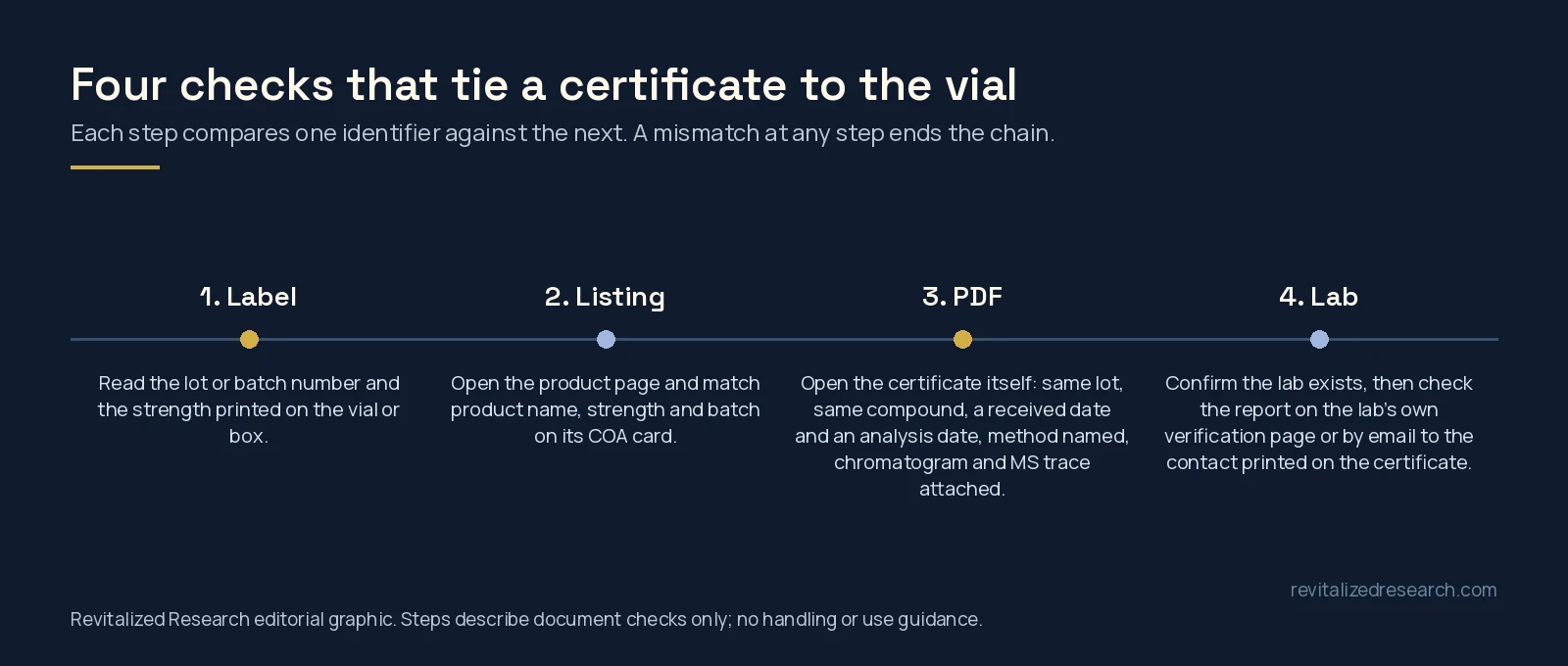
Start with the vial or box. Write down the lot or batch number and the strength exactly as printed. Then open the product page and find the certificate shown for that listing. The batch number has to match character for character, including prefixes and suffixes, and the strength has to match too: a certificate for one strength or format is not evidence for another. Finally open the PDF itself and check that the lot number on the certificate is the same one, under the same compound name.
If the label, the listing and the PDF disagree at any point, stop there. A mismatch does not prove the material is bad, but it does mean the certificate you are looking at is not documentation of the vial you have.
Step 2: confirm the lab is real, and that it issued this report
A third-party certificate is issued by an outside laboratory to a named client. An in-house certificate is produced by the seller or manufacturer about its own material. In-house quality control is normal in manufacturing, but it is the seller vouching for itself; an outside lab with its own name, domain and contact details adds a check the seller does not control.
On the certificate, look for the lab’s name or domain, the client name, a lot or report number, the date the sample was received, the date the analysis was run, the method used and the name of the analyst or reviewer. Then check the lab independently:
- Find the lab’s website yourself rather than clicking a link inside the PDF. A forged certificate can carry a forged email address.
- Use the lab’s own verification page if it has one. Some labs look reports up by report number and treat the lot number as optional, so note both if both are printed.
- If the certificate shows a lot number but no report number, email the lab using the contact on its own site with the lot number, the client name and the analysis date, and ask it to confirm the report and its result.
Step 3: know which claims the certificate actually makes
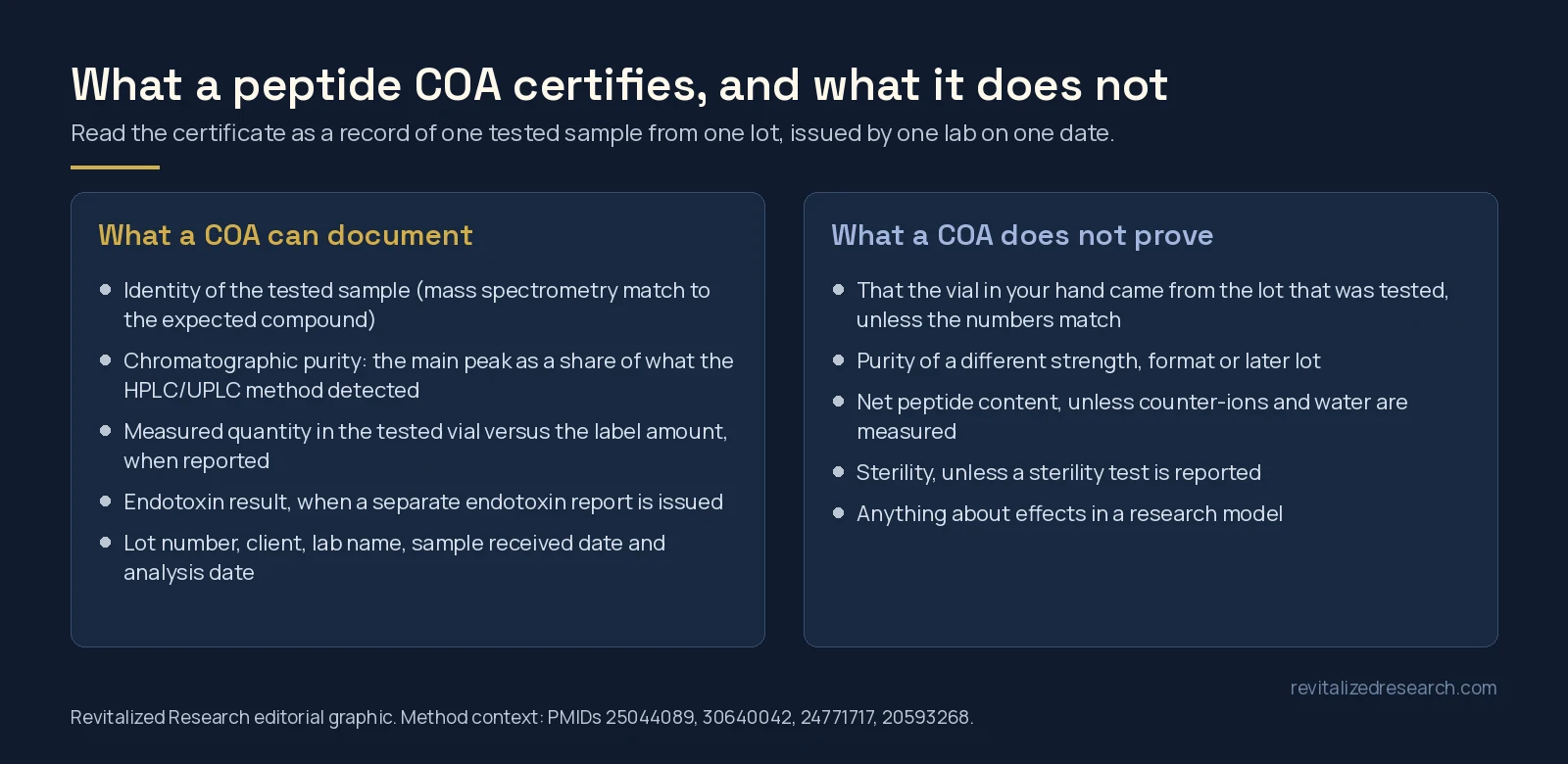
Different tests answer different questions, and a certificate only covers the tests it reports. Our post on HPLC vs. mass spectrometry in peptide purity testing explains the two core methods; the table below sets out what each result does and does not establish.
| Result on a COA | What it answers | What it does not answer | Sources |
|---|---|---|---|
| HPLC or UPLC purity (%) | How much of the detected signal sits in the main peak under that method | Material the detector does not see well, such as water and counter-ions; impurities that co-elute with the main peak | [6] [7] |
| Mass spectrometry identity | Whether the tested sample contains a molecule with the expected mass (and, with MS/MS, expected fragments) | How much of it is present; subtle modifications unless specifically looked for | [2] [8] |
| Quantity or net peptide content | How much peptide was measured in the tested vial versus the label amount | Purity; it also depends on how counter-ions such as trifluoroacetate and water were handled | [7] [9] |
| Endotoxin (EU/mL or EU/mg) | Bacterial endotoxin measured by an LAL or recombinant factor C assay | Sterility; and some sample matrices can mask endotoxin in LAL tests | [10] [11] [12] |
| Impurity profile | Named related substances, such as deletion or insertion sequences, oxidized or racemized forms | Anything outside the method’s scope | [6] [13] |
The impurity point matters more than it looks. Solid-phase synthesis can leave peptides with missing or extra amino acids, racemized residues, oxidized side chains, leftover protecting groups and trifluoroacetate counter-ions, and storage adds degradation products on top [6]. Regulators note that characterizing peptide-related impurities cannot simply borrow the small-molecule approach [13]. A single purity number compresses all of that into one figure, which is why the chromatogram behind it is worth seeing. On quantity, a multi-laboratory USP study compared HPLC assay, quantitative NMR and amino acid analysis for oxytocin and found the methods differ in reproducibility [7], and a 2025 study argued that counter-ion content should be quantified and specified in work with synthetic peptides [9].
Endotoxin results need the same care. The LAL test has been the standard tool for decades [10], recombinant factor C reagents have been validated as an alternative [12], and the low endotoxin recovery effect means some formulations can read lower than they should [11]. An endotoxin line on a certificate is useful, but it is not a sterility result.
Red flags that a certificate cannot be trusted
- No dates. A certificate with no received or analysis date cannot be tied to a lot that is on the shelf now.
- One report number on different compounds. A report number identifies one test of one sample. Seeing it on certificates for unrelated products means at least one of them is not what it claims.
- Purity with no chromatogram. A percentage with no trace and no method named cannot be checked by anyone.
- No lab named. A certificate with a seller logo and no testing lab is an in-house statement at best.
- “COA on request” with nothing posted. Documentation that only appears after you ask cannot be compared before you order.
- Image-only certificates that cannot be checked. A cropped screenshot with no lot number, no lab contact and no way to look the report up is a picture, not a record.
- Compound data that does not match public references. CAS number, molecular formula and PubChem CID can be checked against PubChem in a minute.
- Dates out of order. An analysis date earlier than the sample received date is a basic inconsistency.
A verification checklist
| Check | Where to look | A pass looks like |
|---|---|---|
| Lot number | Vial label, product listing, certificate PDF | Identical in all three places |
| Compound and strength | Label and certificate | Same compound name and the same strength or format |
| Testing lab | Certificate header and footer | A named lab with its own domain and contact details |
| Dates | Certificate | Received and analysis dates present and in order |
| Method and raw data | Certificate pages | Method named; chromatogram and mass spectrum attached |
| Compound references | Certificate and PubChem | CAS, formula and CID agree with PubChem |
| Endotoxin | Separate report, if issued | Same lot core, a result with units, the same lab |
| Lab confirmation | Lab’s own verification page or email | The lab confirms the report, the client and the result |
How the Revitalized Research COA library is organized
The Revitalized Research COA library lists certificates as one card per product listing. Each card names the product (linking to its product page) and shows four fields: batch, purity, date and lab. A View button opens the certificate pages, and cards marked PDF carry the original certificate file. Pen listings have their own cards alongside the vial listings, and the same card appears on each product page, so the number on the listing and the number in the library can be compared directly.
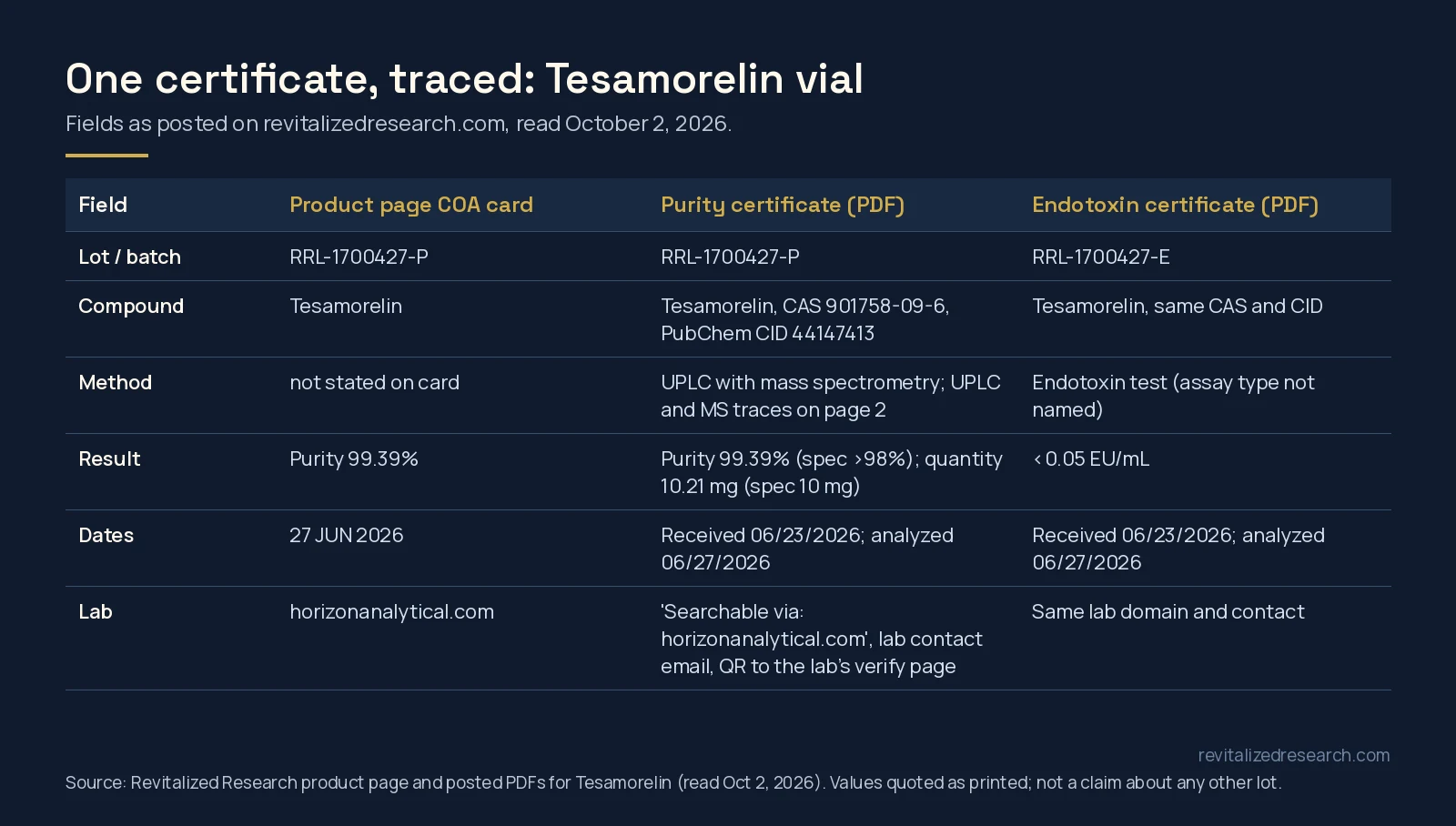
Tracing one example end to end: the Tesamorelin vial listing shows batch RRL-1700427-P, purity 99.39%, date 27 JUN 2026 and lab horizonanalytical.com. The purity certificate behind that card carries the same lot number, names the compound with its CAS number and PubChem CID, states the method as UPLC with mass spectrometry, reports purity of 99.39% against a specification of greater than 98% and a measured quantity of 10.21 mg against 10 mg, gives a received date of 06/23/2026 and an analysis date of 06/27/2026, and attaches the UPLC and MS traces on a second page. A separate endotoxin certificate for lot RRL-1700427-E, sharing the same numeric core, reports a result of less than 0.05 EU/mL. Both certificates print the lab’s contact email and a QR code that opens the lab’s verification page.
The same structure applies elsewhere in the catalog. The BPC-157 listing shows batch RRL-9628420-P with a purity of 99.42% dated 01 JUN 2026, and the TB-500 listing shows batch RRL-8408241-P with a purity of 99.34% dated 09 JUL 2026; both cards include purity and endotoxin pages. Where a listing has no card yet, a batch certificate for this listing is posted on the product page when available. Those values describe the posted lots only; when a new lot ships, its own certificate is the one to match.
What a verified COA still does not show
A certificate that passes every check documents one tested sample at one point in time. It does not describe how the vial was handled after testing, it does not cover other lots or strengths, and it says nothing about results in any research model. The surveillance studies above show why documentation matters [1] [3], but they also show its limit: the only thing a certificate can establish is what the lab measured in the sample it received.
Frequently asked questions
How do I verify a peptide COA?
Match the lot number on the vial to the product listing and the certificate PDF, confirm the certificate names a real lab with received and analysis dates, then check the report on the lab’s own verification page or by contacting the lab with the lot number.
What is the difference between a third-party and an in-house COA?
An in-house COA is issued by the seller or manufacturer about its own material. A third-party COA is issued by an outside laboratory to a named client, which adds a check the seller does not control.
Does a high HPLC purity mean the peptide is correct?
No. HPLC purity describes how the detected signal is distributed among peaks. Identity needs a mass spectrometry match, and the amount of peptide needs a quantity or net content result.
Is an endotoxin result the same as a sterility test?
No. An endotoxin test measures bacterial endotoxin, usually by an LAL or recombinant factor C assay. Sterility is a separate test and is only covered if the certificate reports it.
What should I do if the lot number on my vial does not match the COA?
Treat the certificate as unverified for that vial and contact the seller with the lot number printed on the label. A matching certificate for the correct lot is what documents the material.
References
- Ashraf AR, Mackey TK, Vida RG et al. (2024). Market-surveillance and product-purchase study of peptide products sold online. J Med Internet Res. PMID: 39509151. doi: 10.2196/65440.
- Breindahl T, Evans-Brown M, Hindersson P et al. (2015). Identification and characterization by LC-UV-MS/MS of peptide products sold on the Internet. Drug Test Anal. PMID: 24771717. doi: 10.1002/dta.1655.
- Fabresse N, Gheddar L, Kintz P et al. (2021). Analysis of pharmaceutical products and dietary supplements seized from the black market among bodybuilders. Forensic Sci Int. PMID: 33838562. doi: 10.1016/j.forsciint.2021.110771.
- Weber C, Krug O, Kamber M et al. (2017). Qualitative and Semiquantitative Analysis of Doping Products Seized at the Swiss Border. Subst Use Misuse. PMID: 28156209. doi: 10.1080/10826084.2016.1263665.
- Janvier S, De Spiegeleer B, Vanhee C et al. (2018). Falsification of biotechnology drugs: current dangers and/or future disasters?. J Pharm Biomed Anal. PMID: 30165334. doi: 10.1016/j.jpba.2018.08.037.
- D’Hondt M, Bracke N, Taevernier L et al. (2014). Related impurities in peptide medicines. J Pharm Biomed Anal. PMID: 25044089. doi: 10.1016/j.jpba.2014.06.012.
- Li C, Bhavaraju S, Thibeault MP et al. (2019). Survey of peptide quantification methods and comparison of their reproducibility: A case study using oxytocin. J Pharm Biomed Anal. PMID: 30640042. doi: 10.1016/j.jpba.2018.12.028.
- Jiang H, Wu SL, Karger BL et al. (2009). Mass spectrometric analysis of innovator, counterfeit, and follow-on recombinant human growth hormone. Biotechnol Prog. PMID: 19224592. doi: 10.1002/btpr.72.
- Erckes V, Streuli A, Chamera Rendueles L et al. (2025). Towards a Consensus for the Analysis and Exchange of TFA as a Counterion in Synthetic Peptides and Its Influence on Membrane Permeation. Pharmaceuticals (Basel). PMID: 40872554. doi: 10.3390/ph18081163.
- Ding JL, Ho B (2010). Endotoxin detection–from limulus amebocyte lysate to recombinant factor C. Subcell Biochem. PMID: 20593268. doi: 10.1007/978-90-481-9078-2_9.
- Cao Y, Zhang Y, Qiu F (2021). Low endotoxin recovery and its impact on endotoxin detection. Biopolymers. PMID: 34407207. doi: 10.1002/bip.23470.
- Bolden J, Smith K (2017). Application of Recombinant Factor C Reagent for the Detection of Bacterial Endotoxins in Pharmaceutical Products. PDA J Pharm Sci Technol. PMID: 28733334. doi: 10.5731/pdajpst.2017.007849.
- Colalto C (2024). Aspects of complexity in quality and safety assessment of peptide therapeutics and peptide-related impurities. A regulatory perspective. Regul Toxicol Pharmacol. PMID: 39243929. doi: 10.1016/j.yrtph.2024.105699.