
Peptide sequences are often written with small additions at the ends: an -NH2 after the last residue, or an Ac- before the first. These mark the two most common end modifications, C-terminal amidation and N-terminal acetylation. They look minor on paper, but each one changes the charge, the mass and sometimes the behavior of the peptide, so they matter when you read a data sheet or compare two products with the same core sequence. This guide explains both.
The two ends of a peptide
A linear peptide has a free amine (-NH3+ at neutral pH) at its N-terminus and a free carboxylic acid (-COO– at neutral pH) at its C-terminus. These two charged groups contribute to the peptide’s overall charge, solubility and interactions. End modifications replace one or both of them with an uncharged group.
C-terminal amidation
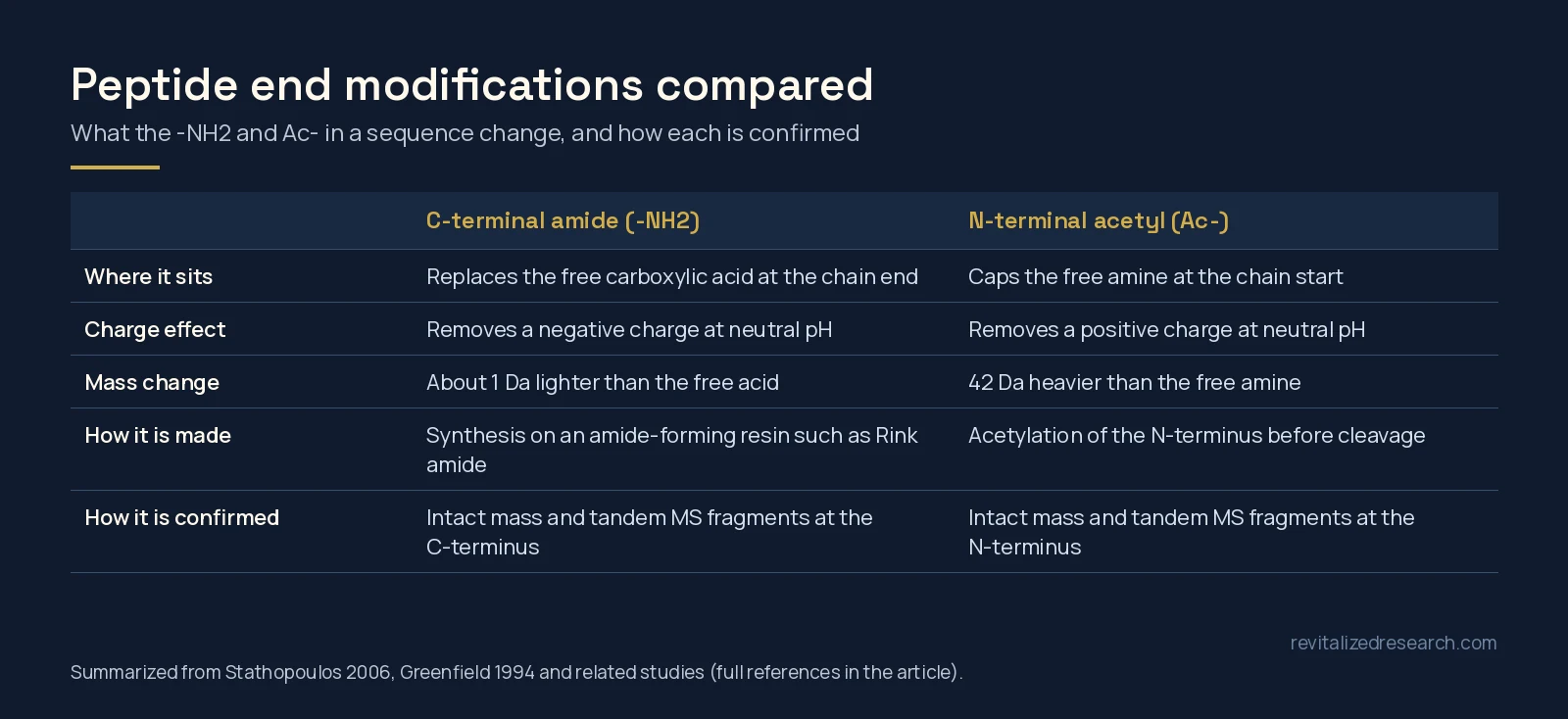
In a C-terminal amide, the final -COOH becomes -CONH2. Many naturally occurring peptides carry this group; in nature it is made enzymatically from a glycine-extended precursor, and in one early study a precursor with an extra C-terminal dibasic extension was converted to the amidated tripeptide about ten times faster [1].
What it changes
Removing the negative charge at the C-terminus raises the net charge of the peptide by one at neutral pH and can change how it interacts with membranes and with other molecules. In molecular simulations of the amphibian peptide uperin 3.5, the amidated form attached rapidly to a model lipid bilayer and formed a stable alpha-helix, while the free-acid form interacted more weakly [2]. Because of effects like these, the amide and free-acid versions of the same sequence should be recorded as different compounds in research notes.
How it is made
Synthetic C-terminal amides are usually built on an amide-forming resin such as the Rink amide resin, which releases the peptide as an amide during acid cleavage. This brings its own side reaction: decomposition of the Rink amide linker during trifluoroacetic acid cleavage can alkylate the C-terminal amide, a problem that adding 1,3-dimethoxybenzene to the cleavage mixture almost completely prevented [3].
N-terminal acetylation
In N-terminal acetylation, an acetyl group (CH3CO-) caps the free amine at the start of the chain, written as “Ac-” in the sequence. This removes a positive charge at neutral pH.
What it changes
Acetylation can stabilize structure near the chain start. In a synthetic 32-residue peptide from the N-terminal region of alpha-tropomyosin, N-terminal acetylation, like disulfide crosslinking, greatly stabilized the coiled-coil alpha-helical conformation at high ionic strength [4]. In a study of a synthetic 18-residue peptide, the acetylated analog showed higher helical content in model membrane vesicles despite its lower net charge [5].
N-terminal modifications are also used to slow enzymatic breakdown in laboratory assays. In one series of designed peptide analogues, adding fatty acid chains to the N-terminus significantly improved stability in serum and trypsin solutions, with longer chains giving more stable analogues [6].
How end modifications are confirmed
Intact mass
Each modification has a predictable mass shift. An N-terminal acetyl group adds 42 Da. A C-terminal amide is about 1 Da lighter than the free acid, the same size of change as deamidation, which is covered in our oxidation vs deamidation guide. The expected mass on a COA should be calculated for the exact form, with or without the modification.
Tandem mass spectrometry
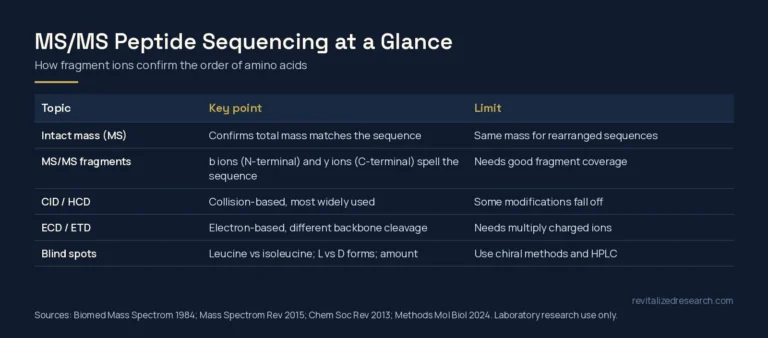
Because a 1 Da difference is small, laboratories confirm the C-terminal form with fragment ions from tandem MS, which show where along the chain the mass shift sits. The same approach locates other small modifications; in a study of a designed peptide, LC with high-resolution tandem MS separated and identified acetylated isomers among dozens of related species [7]. Our HPLC vs mass spectrometry guide explains how identity is established.
| Written in a sequence as | Meaning | Mass effect |
|---|---|---|
| H-…-OH | Free N-terminal amine and free C-terminal acid | Reference form |
| H-…-NH2 | C-terminal amide | About 1 Da lighter than the free acid |
| Ac-…-OH | N-terminal acetyl, free C-terminal acid | 42 Da heavier than the free amine |
| Ac-…-NH2 | Both ends capped | Both shifts combined |
Reading a data sheet with end modifications in mind
- Check both ends of the written sequence. “-NH2” and “Ac-” are part of the compound’s identity, not decoration.
- Match the molecular formula. For example, the Ipamorelin product page lists its formula and CAS number; the expected mass on any report should match that exact form.
- Compare like with like. An amide and a free acid of the same sequence differ in charge and may behave differently in assays.
- Remember the counterion. Capping an end changes how many charged groups pair with counterions, as explained in our TFA vs acetate guide.
Identity and purity data for each lot in our catalog are published in the Revitalized Research COA library; see how to read a peptide COA for the full checklist.
All Revitalized Research products are sold for laboratory research use only. They are not for human or veterinary use. This article describes analytical chemistry and does not make any claim about biological effects.
Frequently asked questions
What does -NH2 at the end of a peptide sequence mean?
It means the peptide has a C-terminal amide: the final carboxylic acid has been replaced with a -CONH2 group. This removes the negative charge at the C-terminus and makes the peptide about 1 Da lighter than the free acid.
What does Ac- at the start of a peptide sequence mean?
It means the N-terminal amine is capped with an acetyl group. This removes the positive charge at the N-terminus and adds 42 Da to the mass.
Why are synthetic peptides amidated or acetylated?
Some sequences carry these groups in nature, and both modifications change charge and can affect structure, interactions and stability against enzymes in laboratory assays. The modified and unmodified forms should be recorded as different compounds.
How is a C-terminal amide made in synthesis?
It is usually made on an amide-forming resin such as the Rink amide resin, which releases the peptide as an amide during acid cleavage. The cleavage mixture is chosen to limit linker-related side reactions.
How do labs confirm an end modification?
Intact mass shows the expected shift, and tandem mass spectrometry fragments confirm where along the chain the change sits, which is important for the small 1 Da difference of an amide.
References
- Gomez S, di Bello C, Lam TH et al. (1984). C-terminal amidation of neuropeptides. Gly-Lys-Arg extension an efficient precursor of C-terminal amide. FEBS Lett. PMID: 6421618. doi: 10.1016/0014-5793(84)80853-4.
- Chaudhary A, Prasad AK, Martin LL et al. (2025). C-Terminal Amidation: Structural Insights into Enhanced Antimicrobial Peptide Efficacy and Amyloidogenesis. Langmuir. PMID: 41057227. doi: 10.1021/acs.langmuir.5c01571.
- Stathopoulos P, Papas S, Tsikaris V (2006). C-terminal N-alkylated peptide amides resulting from the linker decomposition of the Rink amide resin: a new cleavage mixture prevents their formation. J Pept Sci. PMID: 16103992. doi: 10.1002/psc.706.
- Greenfield NJ, Stafford WF, Hitchcock-DeGregori SE (1994). The effect of N-terminal acetylation on the structure of an N-terminal tropomyosin peptide and alpha alpha-tropomyosin. Protein Sci. PMID: 8019411. doi: 10.1002/pro.5560030304.
- Zanin LP, de Araujo AS, Juliano MA et al. (2016). Effects of N-terminus modifications on the conformation and permeation activities of the synthetic peptide L1A. Amino Acids. PMID: 26920749. doi: 10.1007/s00726-016-2196-1.
- Li R, He S, Yin K et al. (2021). Effects of N-terminal modifications on the stability of antimicrobial peptide SAMP-A4 analogues against protease degradation. J Pept Sci. PMID: 34028137. doi: 10.1002/psc.3352.
- Huo Y, Xu K, Lu Y et al. (2022). Characterization of structurally related peptide impurities using HPLC-QTOF-MS/MS: application to Cbf-14, a novel antimicrobial peptide. Anal Bioanal Chem. PMID: 35840670. doi: 10.1007/s00216-022-04205-1.