
Most synthetic peptides are not sold as the bare peptide molecule. They are salts: the peptide carries positive charges, and each charge is paired with a small negative ion called a counterion. On a certificate of analysis or a data sheet you will usually see one of three: trifluoroacetate (TFA), acetate or chloride. This guide explains where each one comes from, why the choice matters for some kinds of laboratory work, and how the counterion content is actually measured.
Why most synthetic peptides start as TFA salts
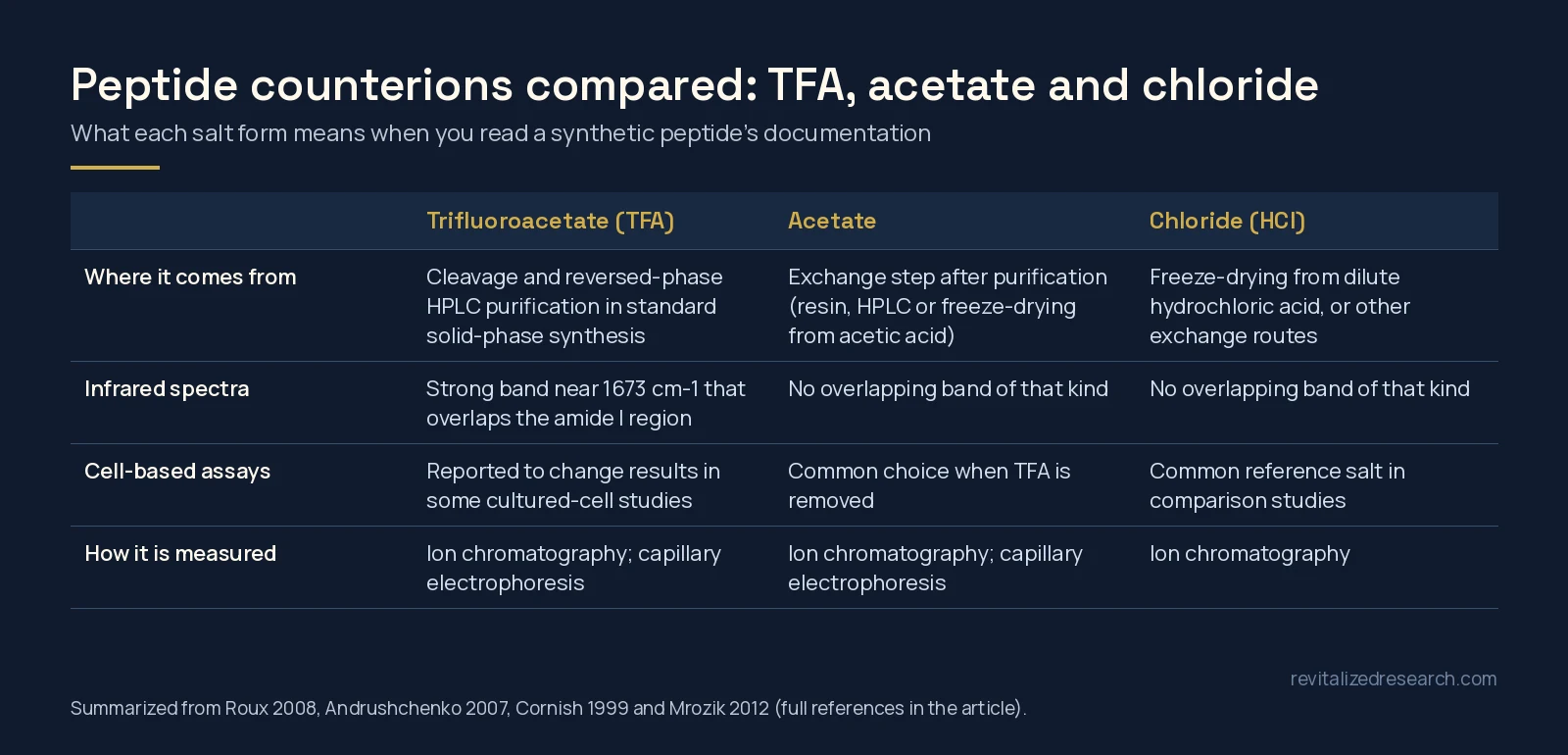
Most peptides today are made by solid-phase synthesis. The cleavage step that releases the finished chain from the resin, and the reversed-phase HPLC purification that follows, both use trifluoroacetic acid. As a result, peptides with basic groups are mainly obtained as trifluoroacetate salts [1]. Fmoc-based synthesis can leave significant amounts of trifluoroacetate in the final material, either bound as the counterion or as an unbound residue [2], and one research group described TFA as almost always present in commercially synthesized peptides [3].
The reason TFA is used in purification is chromatographic. It acts as an ion-pairing reagent: it pairs with the charged peptide and changes how the peptide is retained on a C18 column. Nuclear Overhauser NMR experiments have given direct evidence that peptide and TFA form ion pairs in the acetonitrile and water mixtures used for these separations [4]. That pairing is exactly why the counterion stays with the peptide after the solvent is removed.
How many counterions does a peptide carry?
The number depends on the sequence. Each basic site that is protonated under acidic conditions can hold one counterion: the free N-terminal amine and the side chains of lysine, arginine and histidine. A peptide with several basic groups carries several counterions per molecule, and these can be tightly bound; one study describes the trifluoroacetate on the doubly charged octapeptide lanreotide as tightly bound and hard to exchange [1].
Two examples from our catalog: Selank (Thr-Lys-Pro-Arg-Pro-Gly-Pro) has a lysine and an arginine in addition to its N-terminus, and Ipamorelin carries a histidine and a lysine. Both are basic sequences, so both form salts with whatever acid was present last in their processing.
Why the counterion can matter in the lab
Infrared and structural work
Trifluoroacetate has a strong infrared absorption band at 1673 cm-1. That band overlaps, and can completely hide, the amide I band that researchers use to estimate peptide secondary structure, so TFA has to be removed before IR spectroscopy can be used for that purpose [3]. The same interference with infrared characterization is one of the reasons given for exchanging TFA in the first place [1].
Cultured-cell experiments
In a 1999 study, trifluoroacetate at 10-8 to 10-7 M reduced cell numbers in fetal rat osteoblast cultures within 24 hours, with similar results in chondrocyte cultures. When the TFA and hydrochloride salts of the same peptides were compared, the TFA salts consistently gave lower proliferation, which could hide a real effect or create a false one. The authors recommended converting peptides to a hydrochloride or equivalent salt before cell-based testing [5].
The picture is not one-directional. A later comparison of acetate, hydrochloride and trifluoroacetate salts of five antimicrobial peptides found substantial differences between the salt forms in antibacterial and cultured-cell assays, but the pattern was not consistent from one peptide to the next [6]. The practical point for a lab is simple: when results from two lots are compared, the salt form should be the same, or at least recorded.
How TFA is exchanged for acetate or chloride
The classic method is to freeze-dry the peptide several times from an excess of a stronger acid, usually hydrochloric acid. Working below pH 1 can degrade some peptides, so other routes have been tested: exchange on reversed-phase HPLC, ion-exchange resin, and a deprotonation and reprotonation cycle of the amino groups. The first two can partially or almost completely replace TFA with the anion of a weaker acid such as acetic acid [1].
Concentration matters for the HCl route. In work on the tryptophan-rich peptide indolicidin, HCl above 10 mM in unbuffered solution changed the peptide’s structure and lowered its thermal stability, while 2 to 10 mM removed essentially all TFA without changing secondary structure [3]. Exchange in HCl-saturated organic solvents has been reported as a faster alternative with good efficiency for a model peptide [2], and freeze-drying from acetic acid has also been shown to bring TFA down to satisfactory levels [7].
Each exchange step costs some material and adds handling, which is part of why acetate and chloride salts take more work to produce than the TFA salt that comes straight off the purification column.
How counterion content is measured
An HPLC purity figure does not measure the counterion. Purity describes how much of the peptide-related signal belongs to the main peak, while the counterion is a separate small ion that needs its own method. In a comparison of ion chromatography, capillary electrophoresis and isotachophoresis for acetate, trifluoroacetate and chloride in synthetic peptides, ion chromatography gave the best results and capillary electrophoresis was comparable apart from its detection limits [7]. A dedicated ion chromatography method with suppressed conductivity detection measured residual TFA in a commercial peptide with detection limits below 90 ng/mL [8].
This is also why the mass of a peptide powder is not all peptide. A typical research sample consists of the peptide, its counterion and some water [6]. Our guide to reading a peptide COA covers how purity is reported, and HPLC vs mass spectrometry explains what each identity and purity method can and cannot show.
| Question | Where to look |
|---|---|
| Which salt form is this lot? | The product data sheet or COA, often written after the name (for example “acetate” or “TFA salt”) |
| How much counterion is present? | A separate ion chromatography or capillary electrophoresis result, if the lab reports one |
| Is the purity figure affected? | No. HPLC purity compares peptide peaks; the counterion is measured on its own |
| Does it matter for my assay? | Most for infrared spectroscopy and cultured-cell work, where TFA is known to interfere |
A short checklist
- Record the salt form with the lot number in your lab notebook, next to the purity and identity results.
- Keep the salt form constant across lots when comparing results over time.
- Plan for IR work: if you will run infrared spectroscopy, budget for a counterion exchange or a TFA-free form.
- Do not read purity as content. A high HPLC purity says nothing about how much of the powder is counterion or water.
Batch documentation for our catalog, including purity and identity results by lot, is in the Revitalized Research COA library. For a summary of the testing behind each listing, see lab-tested peptides.
All Revitalized Research products are sold for laboratory research use only. They are not for human or veterinary use. This article describes analytical chemistry and does not make any claim about biological effects.
Frequently asked questions
What is the difference between a TFA salt and an acetate salt of a peptide?
Both are the same peptide paired with a different counterion. A TFA salt carries trifluoroacetate, which comes from the cleavage and HPLC purification steps of solid-phase synthesis. An acetate salt has been through an extra exchange step that replaces trifluoroacetate with acetate.
Why do synthetic peptides contain TFA?
Trifluoroacetic acid is used to release the peptide from the synthesis resin and as an ion-pairing reagent in reversed-phase HPLC purification. Peptides with basic groups keep trifluoroacetate as their counterion after the solvent is removed.
Does the counterion change the HPLC purity result?
No. HPLC purity compares the main peptide peak with other peptide-related peaks. The counterion is a separate small ion and is measured with its own method, most often ion chromatography.
When does TFA interfere with lab work?
Trifluoroacetate absorbs strongly near 1673 cm-1, which overlaps the amide I band used in infrared studies of secondary structure. Published work also reports that TFA can change results in some cultured-cell experiments.
How is TFA removed from a peptide?
Common routes are repeated freeze-drying from dilute hydrochloric acid or acetic acid, exchange on an ion-exchange resin, and exchange during reversed-phase HPLC. The acid concentration matters, because very acidic conditions can change some peptides.
References
- Roux S, Zékri E, Rousseau B et al. (2008). Elimination and exchange of trifluoroacetate counter-ion from cationic peptides: a critical evaluation of different approaches. J Pept Sci. PMID: 18035848. doi: 10.1002/psc.951.
- Sikora K, Neubauer D, Jaśkiewicz M et al. (2018). Citropin 1.1 Trifluoroacetate to Chloride Counter-Ion Exchange in HCl-Saturated Organic Solutions: An Alternative Approach. Int J Pept Res Ther. PMID: 29720924. doi: 10.1007/s10989-017-9611-7.
- Andrushchenko VV, Vogel HJ, Prenner EJ (2007). Optimization of the hydrochloric acid concentration used for trifluoroacetate removal from synthetic peptides. J Pept Sci. PMID: 17031869. doi: 10.1002/psc.793.
- Åsberg D, Langborg Weinmann A, Leek T et al. (2017). The importance of ion-pairing in peptide purification by reversed-phase liquid chromatography. J Chromatogr A. PMID: 28363419. doi: 10.1016/j.chroma.2017.03.041.
- Cornish J, Callon KE, Lin CQ et al. (1999). Trifluoroacetate, a contaminant in purified proteins, inhibits proliferation of osteoblasts and chondrocytes. Am J Physiol. PMID: 10567002. doi: 10.1152/ajpendo.1999.277.5.E779.
- Sikora K, Jaśkiewicz M, Neubauer D et al. (2018). Counter-ion effect on antistaphylococcal activity and cytotoxicity of selected antimicrobial peptides. Amino Acids. PMID: 29307075. doi: 10.1007/s00726-017-2536-9.
- Mrozik W, Markowska A, Guzik L et al. (2012). Determination of counter-ions in synthetic peptides by ion chromatography, capillary isotachophoresis and capillary electrophoresis. J Pept Sci. PMID: 22252914. doi: 10.1002/psc.1436.
- Kaiser E, Rohrer J (2004). Determination of residual trifluoroacetate in protein purification buffers and peptide preparations by ion chromatography. J Chromatogr A. PMID: 15250411. doi: 10.1016/j.chroma.2004.03.044.