
Many peptides owe their shape to disulfide bonds: covalent links between the sulfur atoms of two cysteine residues. A disulfide can close a single chain into a ring or tie two chains together. In synthetic peptides, getting these links right is a separate step from building the chain, and it brings its own by-products. This guide explains how disulfides are formed, why they can rearrange, and how laboratories verify them.
What a disulfide bond is
Each cysteine carries a thiol (-SH) group. When two thiols are oxidized together, they lose two hydrogens and form one S-S bond. That makes the oxidized peptide 2 Da lighter than its fully reduced form per disulfide, a small difference that mass spectrometry can see. Disulfide bonds play important roles in the structure of peptides and proteins, which is why mapping which cysteines are linked is part of complete structural characterization [1].
How disulfides are formed in synthetic peptides
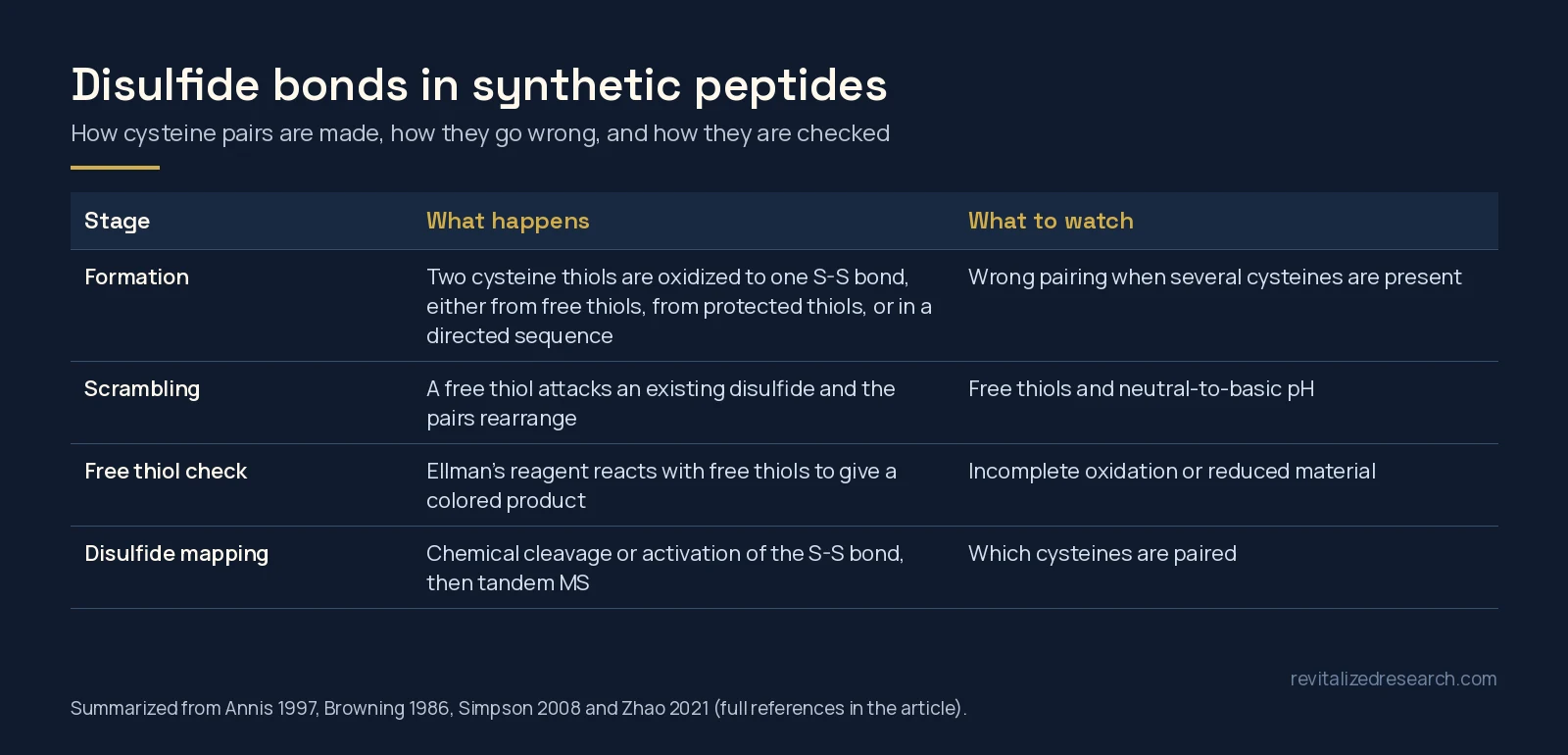
A review of disulfide chemistry in synthetic peptides describes three general approaches: oxidation starting from unprotected thiols, oxidation starting from protected thiols, and directed methods for forming unsymmetrical disulfides. These reactions can be run in solution or on the solid support, and yield and purity depend on the protecting groups, the exact conditions and the target structure [2].
Air oxidation
The simplest route is to let dissolved oxygen do the work. This can be enough for molecules that naturally fold into a shape that brings the right cysteines together; it has been used to join two peptide chains with one disulfide and to cyclize designed peptides through an intramolecular disulfide [3].
Directed, regioselective formation
When a peptide has more than two cysteines, random oxidation can pair the wrong ones. The solution is to protect cysteine pairs with different groups and close them one at a time. The method has to be tailored to each peptide; one published protocol forms three disulfide bonds in sequence to assemble two-chain peptides [4]. Newer on-resin chemistry aims to simplify this: an acid-activated N-chlorosuccinimide method formed clean disulfides in about 15 minutes using common cysteine protecting groups [5].
Disulfide scrambling
Disulfide bonds are not always permanent. A free thiol can attack an existing disulfide and swap partners, which is called scrambling. A classic example: a protein with three cysteines, two of them linked and one free, was converted into all three possible disulfide isomers under denaturing alkaline conditions. The isomers were separated by reversed-phase HPLC and identified by peptide mapping, and a variant without the free cysteine did not scramble [6].
The lesson carries over to synthetic peptides. Free thiols and neutral-to-basic conditions favor rearrangement, so a peptide with incompletely oxidized cysteines can change after it is made. Cysteine is also one of the residues most prone to racemization during synthesis, as covered in our peptide racemization guide.
Unwanted oxidation of free cysteines
For peptides that are meant to keep a free cysteine, oxidation is the problem rather than the goal. Glutathione is a familiar example: its single cysteine oxidizes readily, and analytical protocols block the free thiol with N-ethylmaleimide during sample preparation specifically to stop autooxidation from changing the ratio of glutathione to glutathione disulfide [7]. Some reagents oxidize cysteine to cystine outright; a mixture of dimethyl sulfoxide and hydrochloric acid does this quantitatively [8]. Our oxidation vs deamidation guide covers the related chemistry of methionine.
How disulfides are verified
Free thiol measurement
Ellman’s reagent, 5,5′-dithiobis(2-nitrobenzoic acid) or DTNB, is the standard way to quantify free thiols, and with a reduction step it can also estimate disulfide linkages [9]. A free thiol result above what the sequence should have suggests incomplete oxidation.
Mass spectrometry and disulfide mapping
Intact mass shows how many disulfides have formed, through the 2 Da steps described above. Finding which cysteines are paired is harder, because disulfide bonds do not break readily under standard low-energy fragmentation. Methods therefore cleave or activate the S-S bond chemically first. In one approach, meta-chloroperoxybenzoic acid converts the disulfide to a thiosulfinate in over 60% yield within a minute, and the modified bond then fragments preferentially in tandem MS, revealing the linkage [1].
HPLC
Disulfide isomers often separate on reversed-phase HPLC, as the scrambling example shows [6]. A trace with a cluster of closely spaced peaks around the main peak can be a sign of mixed pairings, which mass data alone may not resolve. See our HPLC vs mass spectrometry guide for how the two methods complement each other.
| Question | How it is answered |
|---|---|
| How many disulfides formed? | Intact mass, about 2 Da lighter per disulfide than the reduced form |
| Are free thiols left? | Ellman’s reagent (DTNB) assay |
| Which cysteines are paired? | Disulfide mapping by chemical activation and tandem MS, or peptide mapping |
| Is the pairing uniform? | Reversed-phase HPLC, where isomers often appear as separate peaks |
Practical points for the lab
- Check the expected mass carefully. Make sure the reference mass on the data sheet is for the oxidized or reduced form you expect.
- Protect free cysteines from air and oxidizing solvents if the sequence is meant to stay reduced.
- Avoid basic conditions for disulfide-containing material when not needed, since free thiols plus higher pH favor scrambling.
- Record lot data. Disulfide status can differ by batch. See how to read a peptide COA.
Lot-level purity and identity results for our catalog, including L-Glutathione, are in the Revitalized Research COA library.
All Revitalized Research products are sold for laboratory research use only. They are not for human or veterinary use. This article describes analytical chemistry and does not make any claim about biological effects.
Frequently asked questions
What is a disulfide bond in a peptide?
A disulfide bond is a covalent S-S link formed when the thiol groups of two cysteine residues are oxidized together. It can close a chain into a ring or join two chains, and it makes the peptide about 2 Da lighter than its reduced form per bond.
How are disulfide bonds formed in synthetic peptides?
Common approaches are oxidation of free thiols, for example by air, oxidation starting from protected thiols, and directed methods that close cysteine pairs one at a time using different protecting groups.
What is disulfide scrambling?
Scrambling is the rearrangement of disulfide pairs when a free thiol attacks an existing disulfide. It is favored by free cysteines and neutral to basic conditions and produces isomers with the wrong pairings.
How do labs check for free thiols?
Ellman’s reagent, also called DTNB, reacts with free thiols to give a colored product that can be measured. With a reduction step, the same chemistry can estimate disulfide content.
How is disulfide connectivity confirmed?
Intact mass shows how many disulfides formed, and disulfide mapping identifies which cysteines are linked, usually by chemically cleaving or activating the S-S bond before tandem mass spectrometry.
References
- Zhao X, Zhang S, Ma Q et al. (2021). Rapid Disulfide Mapping in Peptides and Proteins by meta-Chloroperoxybenzoic Acid (mCPBA) Oxidation and Tandem Mass Spectrometry. Anal Chem. PMID: 34704736. doi: 10.1021/acs.analchem.1c02379.
- Annis I, Hargittai B, Barany G (1997). Disulfide bond formation in peptides. Methods Enzymol. PMID: 9353723. doi: 10.1016/s0076-6879(97)89049-0.
- Calce E, Vitale RM, Scaloni A et al. (2015). Air oxidation method employed for the disulfide bond formation of natural and synthetic peptides. Amino Acids. PMID: 25900810. doi: 10.1007/s00726-015-1983-4.
- Shabanpoor F, Hossain MA, Lin F et al. (2013). Sequential formation of regioselective disulfide bonds in synthetic peptides with multiple disulfide bonds. Methods Mol Biol. PMID: 23943479. doi: 10.1007/978-1-62703-544-6_5.
- Tripathi NM, Das BK, Chowdhury A et al. (2025). Introducing Regioselective Disulfide Linkages in Peptides under Pseudodilute Conditions by Harnessing Bro̷nsted Acid-Activated N-Chlorosuccinimide. JACS Au. PMID: 40017760. doi: 10.1021/jacsau.4c01063.
- Browning JL, Mattaliano RJ, Chow EP et al. (1986). Disulfide scrambling of interleukin-2: HPLC resolution of the three possible isomers. Anal Biochem. PMID: 3487260. doi: 10.1016/0003-2697(86)90236-8.
- Sun X, Berger RS, Heinrich P et al. (2020). Optimized Protocol for the In Situ Derivatization of Glutathione with N-Ethylmaleimide in Cultured Cells and the Simultaneous Determination of Glutathione/Glutathione Disulfide Ratio by HPLC-UV-QTOF-MS. Metabolites. PMID: 32709039. doi: 10.3390/metabo10070292.
- Savige WE, Fontana A (1980). Oxidation of tryptophan to oxindolylalanine by dimethyl sulfoxide-hydrochloric acid. Selective modification of tryptophan containing peptides. Int J Pept Protein Res. PMID: 6155358. doi: 10.1111/j.1399-3011.1980.tb02579.x.
- Simpson RJ (2008). Estimation of Free Thiols and Disulfide Bonds Using Ellman’s Reagent. CSH Protoc. PMID: 21356901. doi: 10.1101/pdb.prot4699.