
When a peptide solution gives a lower reading than expected, the first suspects are usually the peptide content, degradation or a weighing error. There is another, less obvious cause: some of the peptide may be stuck to the container. Peptide adsorption to glass, plastic and pipette tips is a well-documented source of loss in laboratory work, especially at low concentrations. This guide explains what drives it and how labs keep it from skewing results.
How big the effect can be
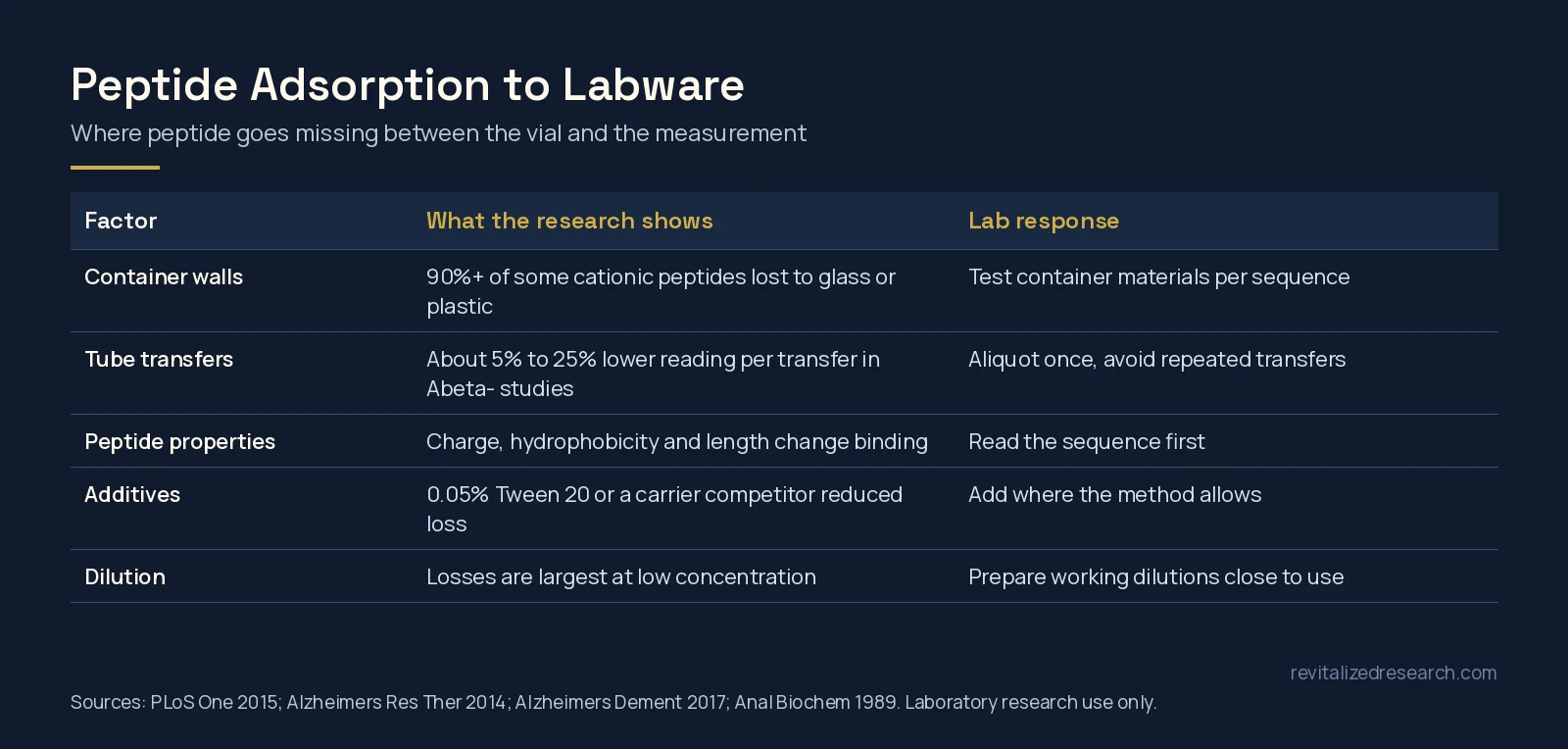
For some peptides the loss is dramatic. A study of three cationic membrane-active peptides (mastoparan X, melittin and magainin 2) used analytical HPLC to measure how much adsorbed to the walls of commonly used glass and plastic sample containers. At typical experimental concentrations, 90% or more of the peptide could be lost from solution through rapid adsorption to the container walls [1].
Smaller losses add up too. In one study of amyloid-beta peptides in cerebrospinal fluid samples, each transfer to a new polypropylene tube lowered the measured Aβ42 concentration by about 25%, and Aβ38 and Aβ40 by about 16% per transfer [2]. Another group found about 5% loss of Aβ 1-42 with every tube transfer, and up to 10% in small volumes; adsorption was seen after only 30 seconds and after contact with the pipette tip [3].
Why some peptides stick more than others
Adsorption depends on the peptide. In the cationic peptide study, positively charged, membrane-active sequences were the focus precisely because they bind readily to surfaces [1]. An analysis of 50 peptides found that their physicochemical properties were linked to how strongly they adsorbed to sample-preparation containers and the LC system, and grouped them into classes by response and degree of adsorption [4]. Length matters as well: quantifying larger neuropeptides of 23 to 36 amino acids by LC-MS/MS proved harder than smaller ones under 15 amino acids, largely because of nonspecific binding [5].
Hydrophobic stretches and positive charges are the features chemists look for first. The same properties that make a sequence hard to dissolve, covered in our guide to peptide solubility and aggregation, often make it more likely to cling to surfaces.
Glass or plastic?
Neither is automatically better. Glass can be a problem: an early study showed that several proteins and peptides adsorbed onto glass during serial dilution, cutting the measured circular dichroism signal by about 50% for the most affected ones, and concluded that adsorption to glass is common and can cause serious experimental errors [6]. That study recommended plastic containers and pipette tips, silicone-coated cells and pre-wetting the cell [6]. Plastic has the same problem, as the polypropylene tube results above show [2] [3]. The best container depends on the sequence and the solvent, which is why many labs test it for each new peptide.
| Factor | Effect on adsorption | Common lab response |
|---|---|---|
| Low concentration | A larger share of the peptide is lost to the walls | Prepare working dilutions fresh and close to use |
| Positive charge, hydrophobic stretches | Stronger binding to surfaces | Test container materials for that sequence |
| Number of transfers | Each new surface removes more peptide | Minimize tube-to-tube transfers |
| Additives | Surfactants or carrier proteins compete for surface sites | Add where the method allows it |
How labs reduce adsorption losses
- Fewer transfers. Since every new tube surface removes more peptide, workflows that aliquot once and avoid repeated transfers lose less [2] [3].
- Surface competitors. Adding the non-ionic surfactant Tween 20 (0.05%) at the first aliquoting step significantly reduced the transfer-related loss of amyloid-beta peptides [2]. For neuromedin U-8 and neuromedin S, adding 0.05% plasma as an adsorption competitor was essential to avoid loss from nonspecific binding [5].
- Solvent and container choice. Systematically testing solvents, containers and the LC system is the general strategy one group set out for reducing adsorption in UPLC-MS peptide analysis [4].
- Ratios instead of absolute values. When two related peptides adsorb similarly, their ratio can stay stable even when each concentration drops. The Aβ 1-42 / Aβ 1-40 ratio stayed stable across multiple tube transfers for this reason [3].
Why this matters when you compare results to a COA
A certificate of analysis describes the material as it was tested. If a lab’s own measurement of a dilute solution comes in lower, adsorption is worth ruling out before assuming the material is off-specification. Peptide content and counterions are the other usual explanations, covered in our guide to peptide purity vs net peptide content. For handling basics, see peptide storage basics for research labs, and every Revitalized Research batch document is in our COA library.
All Revitalized Research products are sold for laboratory research use only. They are not for human or veterinary use. This article describes analytical chemistry and does not make any claim about biological effects.
Frequently asked questions
Why do peptides stick to tubes and vials?
Peptides can bind to glass and plastic surfaces through charge and hydrophobic interactions. Positively charged and hydrophobic sequences tend to bind most strongly, and the effect is largest in dilute solutions.
How much peptide can be lost to adsorption?
It depends on the sequence and conditions. One study found that 90% or more of some cationic peptides could be lost from solution to container walls at typical experimental concentrations, while other studies measured roughly 5% to 25% loss per tube transfer.
Is glass or plastic better for peptide solutions?
Neither is better for every peptide. Adsorption has been documented on both glass and polypropylene, so many labs test container materials for each new sequence.
How can adsorption losses be reduced?
Common approaches are minimizing tube transfers, preparing dilute working solutions close to use, choosing containers and solvents suited to the sequence, and adding a surfactant or carrier protein where the method allows.
Does adsorption affect the COA result?
A COA describes the material as tested by the lab. Adsorption affects solutions prepared later, so a low reading from a dilute solution may reflect losses to labware rather than a problem with the material itself.
References
- Kristensen K, Henriksen JR, Andresen TL (2015). Adsorption of cationic peptides to solid surfaces of glass and plastic. PLoS One. PMID: 25932639. doi: 10.1371/journal.pone.0122419.
- Toombs J, Paterson RW, Schott JM et al. (2014). Amyloid-beta 42 adsorption following serial tube transfer. Alzheimers Res Ther. PMID: 24472496. doi: 10.1186/alzrt236.
- Willemse E, van Uffelen K, Brix B et al. (2017). How to handle adsorption of cerebrospinal fluid amyloid β (1-42) in laboratory practice? Identifying problematic handlings and resolving the issue by use of the Aβ(42)/Aβ(40) ratio. Alzheimers Dement. PMID: 28222302. doi: 10.1016/j.jalz.2017.01.010.
- Zhang Y, Yang J, Ma Y et al. (2022). [Nonspecific adsorption evaluation and general minimization strategy in peptide analysis based on ultra-performance liquid chromatography-mass spectrometry]. Se Pu. PMID: 35791600. doi: 10.3724/SP.J.1123.2021.12012.
- Bongaerts J, De Bundel D, Smolders I et al. (2023). Improving the LC-MS/MS analysis of neuromedin U-8 and neuromedin S by minimizing their adsorption behavior and optimizing UHPLC and MS parameters. J Pharm Biomed Anal. PMID: 36868028. doi: 10.1016/j.jpba.2023.115306.
- Wu CS, Chen GC (1989). Adsorption of proteins onto glass surfaces and its effect on the intensity of circular dichroism spectra. Anal Biochem. PMID: 2500872. doi: 10.1016/0003-2697(89)90036-5.