
Most peptide degradation pathways can hit a residue anywhere in the chain. Pyroglutamate formation is different: it only affects the first residue, and only when that residue is glutamine or glutamic acid. The free amino group at the N-terminus attacks the residue’s own side chain and closes a five-membered ring. This guide explains how the reaction works, what speeds it up, and how labs spot it.
What pyroglutamate is
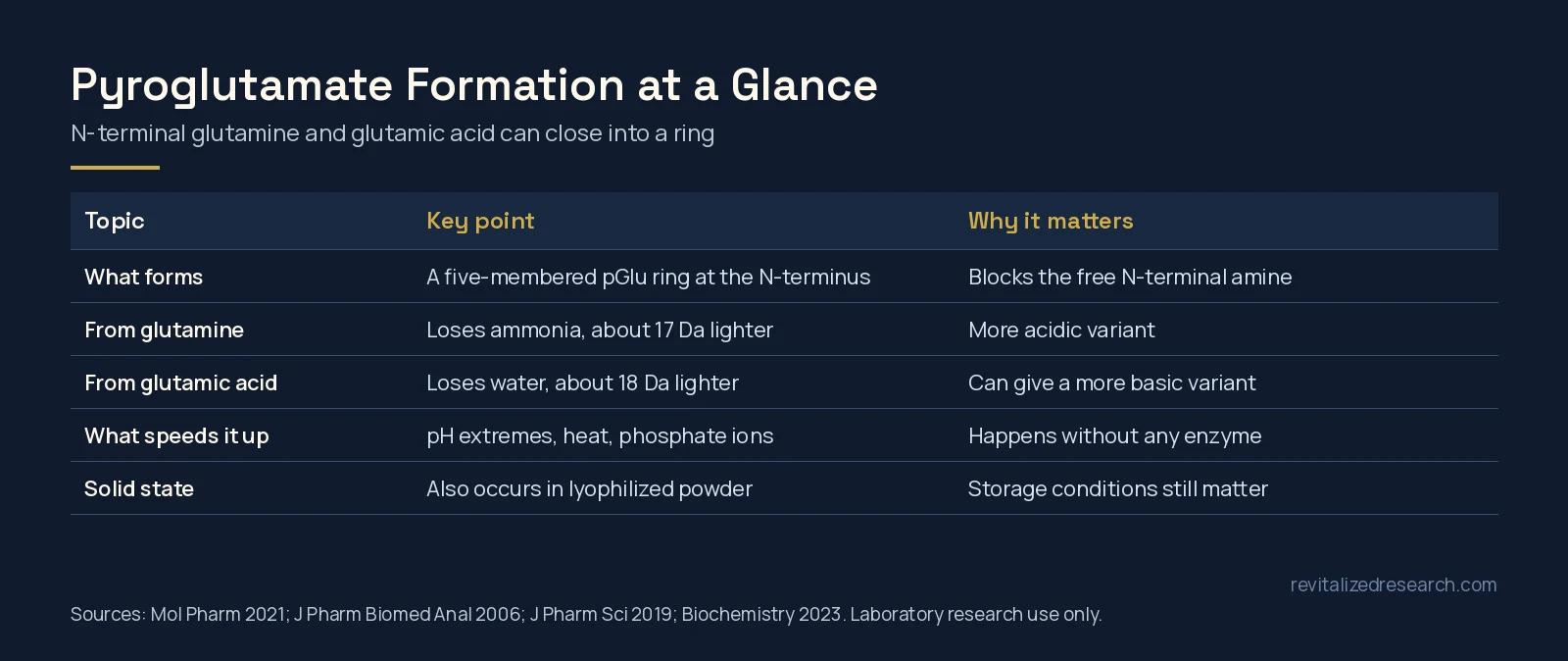
Pyroglutamate (pGlu, also written pE) is a cyclic form of glutamic acid. It forms when an N-terminal glutamine or glutamic acid cyclizes. With glutamine the ring closes with the loss of ammonia; with glutamic acid it closes with the loss of water. Both routes lead to the same pGlu product, an easily overlooked point because the two starting residues differ in charge [1].
The reaction happens in nature as well as in the vial. Formation of N-terminal pGlu is required in the maturation of numerous bioactive peptides, and an enzyme, glutaminyl cyclase, greatly speeds it up in living systems [2]. For a synthetic peptide, though, the concern is the non-enzymatic version that can occur during handling and storage.
Non-enzymatic cyclization: what speeds it up
The reaction does not need an enzyme. In a study of an N-terminal glutamate, pGlu formation was favoured at pH 4 and pH 8 and was less common at neutral pH, showing that cyclization can proceed non-enzymatically under mild conditions; the authors also calculated half-lives of the N-terminal glutamate at different pH values and temperatures [3].
- Temperature. For the glutamine-starting peptide QHALTSV-NH2, the rate of pyroglutamate formation increased with temperature, which the authors described as a reason for caution during laboratory experiments [4].
- Buffer ions. Phosphate ions catalyze pyroglutamate formation from N-terminal glutamine, and kinetic isotope studies suggest they do so by a mode of transition-state stabilization similar to the enzyme’s [5].
- Solid state vs solution. A model peptide starting with glutamate was stored at 50 °C for at least 10 weeks in lyophilized solids and in solution across pH 4 to 9. The pH dependence in the solid state differed markedly from solution, and at pH 5.5 to 6 the rate was greater in the solid state than in solution [6].
That last finding is a useful reminder that chemistry can continue in a dry powder. The general principles of freeze-drying and residual moisture are covered in our guide to how lyophilization works.
How labs detect pyroglutamate
Because cyclization changes the mass, mass spectrometry can usually pick it up. The table below shows the expected shifts.
| Starting N-terminal residue | What is lost | Mass change | Charge effect |
|---|---|---|---|
| Glutamine (Gln, Q) | Ammonia | About 17 Da lighter | Loss of the positive N-terminal amine gives a more acidic variant |
| Glutamic acid (Glu, E) | Water | About 18 Da lighter | Can give a more basic variant, contrary to common assumption |
The charge effect is counter-intuitive. Cyclization of an N-terminal glutamine produces an acidic variant with a lower isoelectric point, but cyclization of an N-terminal glutamic acid was shown to produce a basic variant with a higher isoelectric point, even though both the N-terminal amine and the side-chain acid are lost [1]. That matters for charge-based separation methods.
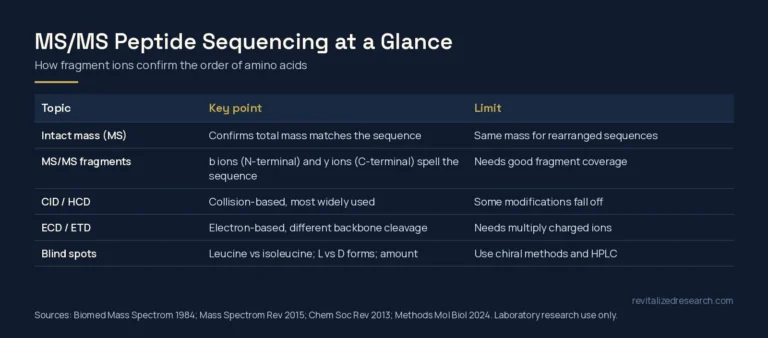
Reversed-phase HPLC is the routine tool for following the reaction over time, as in the solid-state study above, where pGlu formation and loss of the parent peptide were monitored by RP-HPLC [6]. Mass spectrometry-based techniques were developed specifically to investigate N-pyroglutamyl formation [3], and enzymatic conversion with glutaminyl cyclase has been used to deliberately turn all N-terminal glutamine into pGlu, which simplifies chromatograms and confirms the identity of the N-terminal residue [7]. Because the ring blocks the free N-terminus, classic N-terminal sequencing chemistry does not work on pGlu peptides, which is one more reason fragmentation methods are useful, as described in our guide to tandem mass spectrometry.
Why it changes more than the mass
Pyroglutamate is not just a label change. In the CXCR4-derived peptide study, the pyroglutamated analogue behaved differently from the native form: it was more sensitive to solvent changes, showed altered self-assembly with more tightly packed arrangements, and favoured aggregate formation [4]. Aggregation behaviour in general is covered in our guide to peptide solubility and aggregation.
What it means for documentation
For sequences that begin with glutamine or glutamic acid, a peak about 17 or 18 Da below the target mass is a signal worth investigating, and storage conditions matter even for dry powder. Some sequences are designed with pGlu at the start on purpose, in which case the intended structure, not the free glutamine, is the target. Pyroglutamate sits alongside the pathways described in our guide to oxidation vs deamidation, and every Revitalized Research batch document is available in our COA library.
All Revitalized Research products are sold for laboratory research use only. They are not for human or veterinary use. This article describes analytical chemistry and does not make any claim about biological effects.
Frequently asked questions
What is pyroglutamate in a peptide?
Pyroglutamate is a five-membered ring formed when an N-terminal glutamine or glutamic acid cyclizes. The free N-terminal amine reacts with the residue’s own side chain, which blocks the N-terminus.
Which peptides can form pyroglutamate?
Only peptides whose first residue is glutamine or glutamic acid. The reaction needs the free N-terminal amine, so the same residues elsewhere in the chain do not form pyroglutamate this way.
Does pyroglutamate formation need an enzyme?
No. The enzyme glutaminyl cyclase speeds it up in living systems, but the reaction also happens non-enzymatically, and it is influenced by pH, temperature and buffer ions such as phosphate.
Can pyroglutamate form in lyophilized powder?
Yes. In one study a model peptide formed pyroglutamate in lyophilized solids stored at 50 °C, and at some pH values the solid-state rate was faster than in solution.
How is pyroglutamate detected?
Mass spectrometry shows a loss of about 17 Da from N-terminal glutamine or about 18 Da from N-terminal glutamic acid, and reversed-phase HPLC can follow the change over time.
References
- Liu Z, Valente J, Lin S et al. (2019). Cyclization of N-Terminal Glutamic Acid to pyro-Glutamic Acid Impacts Monoclonal Antibody Charge Heterogeneity Despite Its Appearance as a Neutral Transformation. J Pharm Sci. PMID: 31145921. doi: 10.1016/j.xphs.2019.05.023.
- Huang KF, Liu YL, Cheng WJ et al. (2005). Crystal structures of human glutaminyl cyclase, an enzyme responsible for protein N-terminal pyroglutamate formation. Proc Natl Acad Sci U S A. PMID: 16135565. doi: 10.1073/pnas.0504184102.
- Yu L, Vizel A, Huff MB et al. (2006). Investigation of N-terminal glutamate cyclization of recombinant monoclonal antibody in formulation development. J Pharm Biomed Anal. PMID: 16828250. doi: 10.1016/j.jpba.2006.05.008.
- Ferreira MML, de Souza SEG, da Silva CC et al. (2023). Pyroglutamination-Induced Changes in the Physicochemical Features of a CXCR4 Chemokine Peptide: Kinetic and Structural Analysis. Biochemistry. PMID: 37540799. doi: 10.1021/acs.biochem.3c00124.
- Seifert F, Demuth HU, Weichler T et al. (2015). Phosphate ions and glutaminyl cyclases catalyze the cyclization of glutaminyl residues by facilitating synchronized proton transfers. Bioorg Chem. PMID: 25981125. doi: 10.1016/j.bioorg.2015.04.005.
- Bersin LM, Patel SM, Topp EM (2021). Effect of ‘pH’ on the Rate of Pyroglutamate Formation in Solution and Lyophilized Solids. Mol Pharm. PMID: 34232660. doi: 10.1021/acs.molpharmaceut.1c00338.
- Xu W, Peng Y, Wang F et al. (2013). Method to convert N-terminal glutamine to pyroglutamate for characterization of recombinant monoclonal antibodies. Anal Biochem. PMID: 23357233. doi: 10.1016/j.ab.2013.01.017.