
Most research peptides arrive as a small white solid at the bottom of a sealed vial. That solid is made by lyophilization, also called freeze-drying. The process removes water from a frozen peptide solution under vacuum, leaving a dry material that is far more stable than the solution it came from. This guide walks through how lyophilization works, why some cakes look different from others, and why the small amount of water left behind matters.
The three stages
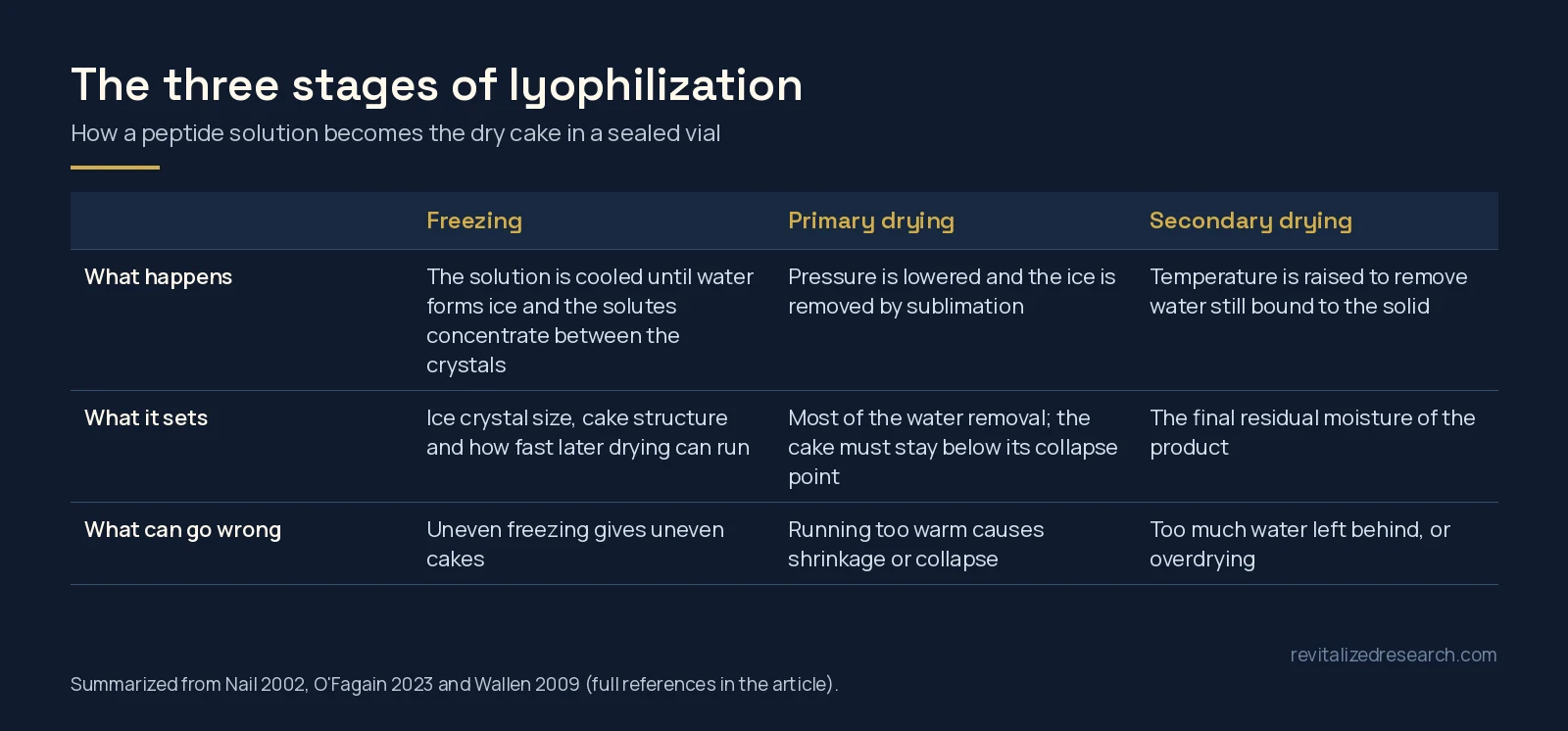
Lyophilization is a complex process made up of three stages: freezing, primary drying and secondary drying [1].
1. Freezing
The peptide solution is cooled until most of the water turns to ice. As ice forms, the peptide and any other dissolved components are pushed into the shrinking spaces between the ice crystals and become highly concentrated. How this concentrated phase behaves when cold, including its glass transition and any crystallization, decides how the material will behave during drying. Characterizing that freezing behavior is the starting point for choosing drying conditions that are fast but still protect the product [2].
2. Primary drying
The chamber pressure is lowered and gentle heat is applied so the ice sublimes, turning straight from solid to vapor. This removes most of the water. The key limit is temperature: the glass transition of the frozen concentrate is the physical event behind collapse during freeze-drying [2], so the product has to stay cold enough that the drying structure does not soften and fall in on itself.
3. Secondary drying
After the ice is gone, some water is still bound within the dried solid. The temperature is raised further to drive off part of this bound water. Secondary drying sets the final residual moisture, which is discussed below.
Why cakes look different
A well-made lyophilized product usually forms a “cake”: a solid, porous block that keeps roughly the shape of the frozen fill. Cakes that have shrunk, cracked, pulled away from the glass, or turned into a dense, glassy film usually point to something that happened during the run.
- Collapse. In a study of protein formulations dried with a slow shelf-temperature ramp at the start of primary drying, all the cakes severely collapsed, which the authors attributed to too little water being removed from the dried matrix before it softened. A fast ramp gave acceptable cakes [3].
- Uneven loading. In large-scale drying of a complex biological product, the way the chamber was loaded changed cake appearance for the first vials loaded, which the authors linked to accidental annealing, a smaller cake surface area and collapse during secondary drying [4].
- Very small fills. A few milligrams of peptide spread across a vial may not form a visible block at all and can look like a thin film or loose powder. Appearance alone does not show whether the material is intact; analytical testing does.
Cake appearance is mainly a clue about the process. Identity and purity still have to come from data such as HPLC and mass spectrometry, as explained in our HPLC vs mass spectrometry guide.
Residual moisture: the water that stays
No freeze-dried product is completely free of water. Residual moisture has two sides. Too much water raises the chemical reactivity of the solid and lowers its glass transition temperature through a plasticizing effect, while overdrying has also been described as harmful to protein stability, so an optimal level has to be established for each product [5]. Researchers studying freeze-dried albumin deliberately set moisture at 1, 1.5 and 2% to measure how water content and the surrounding sugar matrix changed long-term stability [6].
Peptides show the same sensitivity. In a lyophilized model hexapeptide, residual moisture, storage temperature and especially the type of bulking agent all had significant effects on how fast an aspartyl residue degraded in the solid state [7]. That is one reason degradation pathways such as those in our oxidation vs deamidation guide still matter for dry material.
Moisture also affects how much of the powder is actually peptide. Our guide to peptide purity vs net peptide content explains how water and counterions are counted.
Why temperature still matters after drying
A dried amorphous solid is a glass, and reactions inside a glass slow down sharply below its glass transition temperature. In a classic study of an enzyme freeze-dried in a sugar glass, the rate of loss of activity did not follow simple Arrhenius behavior; once temperatures were expressed relative to the glass transition (T minus Tg), samples with different Tg values behaved the same way [8]. The glass transition temperature is commonly measured with modulated differential scanning calorimetry [1].
The practical reading: storing a lyophilized peptide cold keeps it further below its glass transition, and keeping it dry stops water from lowering that transition point. The routine steps are in our peptide storage basics guide.
| What you see | What it can suggest | What to check |
|---|---|---|
| Intact white cake | A controlled drying run | Purity and identity results for the lot |
| Shrunken or cracked cake | Partial collapse or uneven drying | The lot’s purity data; whether all vials look the same |
| Thin film or loose powder | Often just a small fill | Fill amount on the label and the lot’s COA |
| Sticky or glassy material | Moisture uptake, for example after opening | Storage history and seal; keep vials closed and dry |
What this means for a research lab
- Read the cake as a process clue, not as a test result. Use the lot’s analytical data to judge the material.
- Keep vials sealed and cold. Let a cold vial reach room temperature before opening so moisture does not condense inside.
- Record appearance on receipt. A note in the lab log gives you a baseline if anything looks different later.
Lot results for our lyophilized catalog, including Semax and GHK-Cu, are in the Revitalized Research COA library.
All Revitalized Research products are sold for laboratory research use only. They are not for human or veterinary use. This article describes analytical chemistry and does not make any claim about biological effects.
Frequently asked questions
What is peptide lyophilization?
Lyophilization, or freeze-drying, removes water from a frozen peptide solution under vacuum. The process has three stages: freezing, primary drying, where ice sublimes, and secondary drying, where bound water is driven off.
Why does a lyophilized peptide cake sometimes look collapsed?
Collapse happens when the drying structure softens and falls in on itself, usually because it got too warm relative to its glass transition while water was still present. Studies link it to drying temperature ramps and to how vials are loaded.
Does a collapsed or powdery cake mean the peptide is degraded?
Not necessarily. Appearance is a clue about the drying process, and very small fills often look like a film or loose powder. Purity and identity have to be judged from analytical data for the lot.
How much water is left in a freeze-dried peptide?
Some residual moisture always remains. The best level depends on the product: too much water raises reactivity and lowers the glass transition, while overdrying can also be harmful.
Why should lyophilized peptides be stored cold and dry?
A dried peptide is a glass, and reactions inside it slow down far below its glass transition temperature. Cold storage keeps it further below that point, and dry storage stops water from lowering it.
References
- Ó’Fágáin C, Colliton K (2023). Storage and Lyophilization of Pure Proteins. Methods Mol Biol. PMID: 37647008. doi: 10.1007/978-1-0716-3362-5_19.
- Nail SL, Jiang S, Chongprasert S et al. (2002). Fundamentals of freeze-drying. Pharm Biotechnol. PMID: 12189727. doi: 10.1007/978-1-4615-0549-5_6.
- Ohori R, Akita T, Yamashita C (2018). Effect of temperature ramp rate during the primary drying process on the properties of amorphous-based lyophilized cake, Part 2: Successful lyophilization by adopting a fast ramp rate during primary drying in protein formulations. Eur J Pharm Biopharm. PMID: 29913271. doi: 10.1016/j.ejpb.2018.06.010.
- Wallen AJ, Van Ocker SH, Sinacola JR et al. (2009). The effect of loading process on product collapse during large-scale lyophilization. J Pharm Sci. PMID: 18661543. doi: 10.1002/jps.21491.
- Lo Presti K, Frieß W (2021). Adjustment of specific residual moisture levels in completely freeze-dried protein formulations by controlled spiking of small water volumes. Eur J Pharm Biopharm. PMID: 34757155. doi: 10.1016/j.ejpb.2021.10.011.
- Lo Presti K, Frieß W (2025). “Bigger, the Better?”─The Influence of Sugar Size and Residual Moisture on Protein Stability and Accessibility in Lyophilizates. Mol Pharm. PMID: 40987543. doi: 10.1021/acs.molpharmaceut.5c00596.
- Oliyai C, Patel JP, Carr L et al. (1994). Chemical pathways of peptide degradation. VII. Solid state chemical instability of an aspartyl residue in a model hexapeptide. Pharm Res. PMID: 7937533. doi: 10.1023/a:1018998312503.
- Sun WQ, Davidson P, Chan HS (1998). Protein stability in the amorphous carbohydrate matrix: relevance to anhydrobiosis. Biochim Biophys Acta. PMID: 9813351. doi: 10.1016/s0304-4165(98)00077-4.