
An HPLC purity figure tells you what fraction of the peptide material in a sample is the target sequence. It does not tell you how much peptide is actually in the vial, because a lyophilized powder also holds water and counterions. Amino acid analysis (AAA) is one of the classic ways to answer that second question. This guide explains how it works, where it struggles, and how to read it next to the other numbers on a certificate of analysis.
The basic idea: break it down, then count
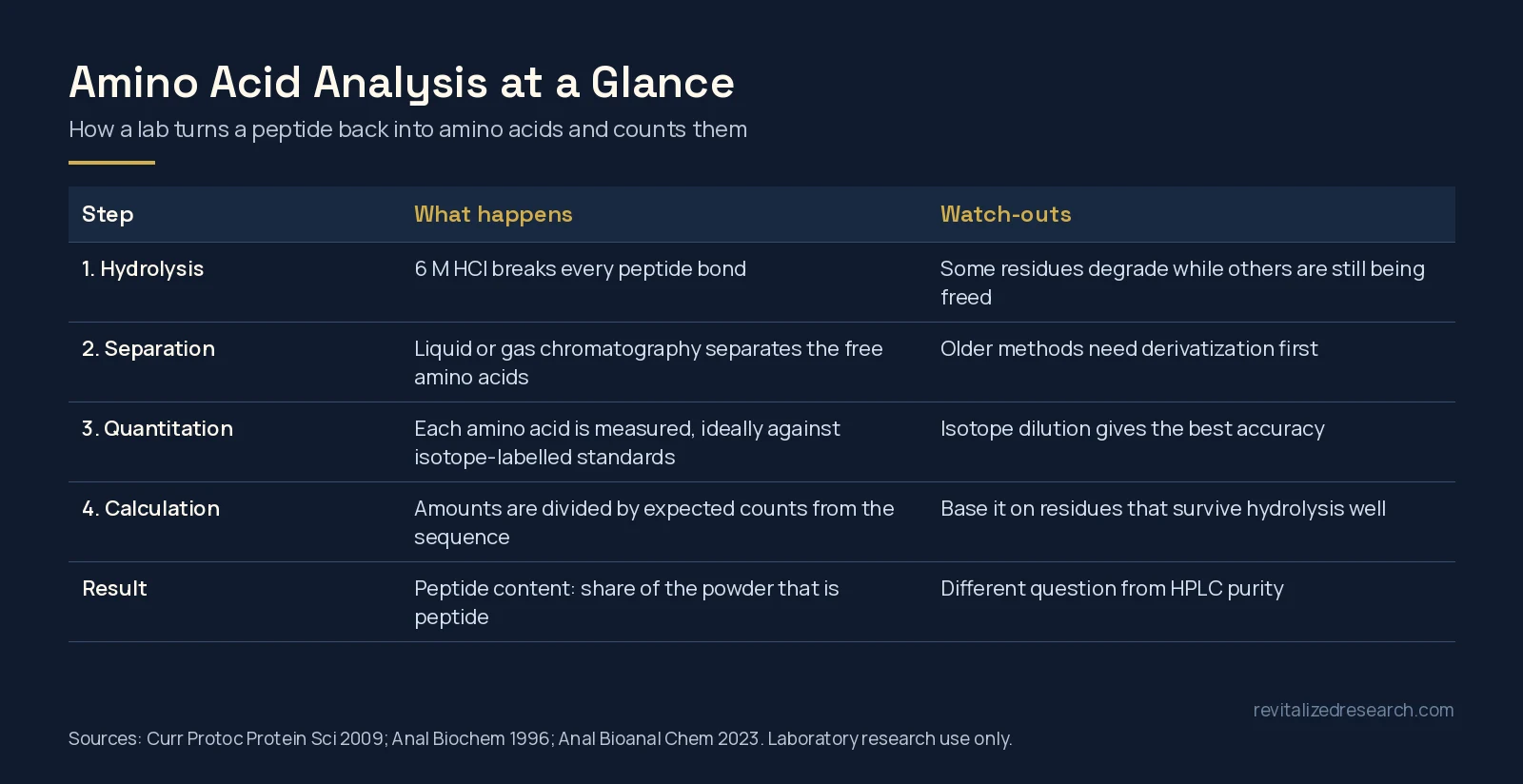
Amino acid analysis measures the amino acid content of a peptide- or protein-containing sample. The first step hydrolyzes every peptide bond. The freed amino acids are then separated, detected and quantified. The approach was developed by Moore, Stein and coworkers in the 1950s using hydrochloric acid hydrolysis, and the core method has changed surprisingly little since [1].
Because the sequence of a synthetic peptide is known, the analyst knows how many of each amino acid one molecule should contain. Dividing the measured amount of each well-behaved amino acid by its expected count gives the amount of peptide in the sample. Comparing that against the mass of powder that was weighed out gives the peptide content, the figure explained in our guide to peptide purity vs net peptide content.
Step 1: acid hydrolysis
The standard approach heats the sample in 6 M hydrochloric acid, and the freed amino acids are then measured, for example by liquid chromatography with mass spectrometry [2]. A complete hydrolysis with a quantitative yield of every residue is the prerequisite for a reliable composition, and studies have compared different acid-hydrolysis methods to find conditions that work across many samples [3].
Hydrolysis is not perfectly clean. Cleaving the peptide bonds and degrading some of the freed amino acids happen at the same time. A classic study hydrolyzed egg-white lysozyme in 6 M HCl over 18 intervals from 2 to 141 hours and modelled the hydrolysis and loss rate for each amino acid, showing that a single 24-hour hydrolysis gives inaccurate estimates of composition [4]. Faster variants exist too: microwave-assisted acid hydrolysis combined with gas chromatography-mass spectrometry quantified a peptide standard with a total hydrolysis time of only 3 hours [5].
Which residues are hard to measure
Some amino acids are routinely awkward in AAA, which is why methods describe extra steps for them, such as performic acid oxidation before hydrolysis for methionine and cysteine [1]. In practice, a lab bases the peptide calculation on the residues that come through hydrolysis reliably and handles the difficult ones with caution.
- Methionine and cysteine are prone to oxidation and are usually handled with a separate oxidation step [1]. Our guide to oxidation vs deamidation covers why these residues are sensitive.
- Asparagine and glutamine are converted to aspartic acid and glutamic acid by acid hydrolysis, so standard AAA reports them combined with their acid forms.
- Tryptophan is largely destroyed by standard HCl hydrolysis, so methods describe a separate base hydrolysis when it must be measured [1].
Acid hydrolysis can also flip a small fraction of amino acids from the L to the D form. Analysts who need to measure D-amino acid residues therefore have to separate original D-residues from those created during hydrolysis, for example with a deuterium-hydrogen exchange method [6]. This is one reason chiral purity is measured with dedicated methods, as described in our guide to peptide racemization and chiral purity.
How the amino acids are counted
After hydrolysis the mixture has to be separated and quantified. Older methods use derivatization so the amino acids can be detected; newer ones measure them directly. One method quantified non-derivatized amino acids, including methionine and cysteine, from peptide hydrolysates by reversed-phase liquid chromatography with multiple reaction monitoring mass spectrometry [2]. Isotope dilution, where a known amount of a heavy-labelled version of each amino acid is added as an internal standard, gives the highest accuracy, and NIST uses isotope dilution LC-MS/MS amino acid analysis to assign concentration values to peptide and protein reference materials [7].
How precise is it?
Amino acid analysis is powerful, but it is not effortless to do well. A study comparing four methods for determining the peptide content of lyophilized thymalfasin (elemental CHN analysis, quantitative AAA, HPLC and Kjeldahl) found that AAA was highly variable in one laboratory while quite precise in another, and that CHN analysis gave highly precise values with under 2% coefficient of variation [8]. For the most demanding work, reference laboratories combine AAA with independent methods: one approach assigned the purity of peptide reference materials by combining qNMR, which measures the intact peptide without hydrolysis, with isotope dilution LC-MS/MS amino acid analysis [9].
| Number on a COA | What it measures | Typical method |
|---|---|---|
| HPLC purity | Share of the peptide material that is the target sequence | Reversed-phase HPLC with UV detection |
| Identity | Whether the main component has the expected mass | Mass spectrometry |
| Peptide content | Share of the weighed powder that is peptide at all | Amino acid analysis, elemental (CHN) analysis or qNMR |
Reading it next to the rest of the COA
A high HPLC purity and a lower peptide content are not a contradiction. They answer different questions, and the gap is mostly water and counterions such as trifluoroacetate or acetate, explained in our guide to TFA vs acetate peptide salts. When a document reports peptide content, it is worth checking which method produced it. You can see how Revitalized Research documents each batch in our COA library, and our HPLC vs mass spectrometry guide covers the purity and identity side.
All Revitalized Research products are sold for laboratory research use only. They are not for human or veterinary use. This article describes analytical chemistry and does not make any claim about biological effects.
Frequently asked questions
What does amino acid analysis measure?
It measures how much of each amino acid is present after a peptide is fully broken down by hydrolysis. Because the sequence of a synthetic peptide is known, those amounts can be converted into how much intact peptide the sample contained.
Is amino acid analysis the same as HPLC purity?
No. HPLC purity is the share of the peptide material that is the target sequence. Amino acid analysis is used to find peptide content, the share of the weighed powder that is peptide at all, as opposed to water and counterions.
Why can some amino acids not be measured accurately?
Acid hydrolysis degrades some residues while it frees them. Methionine and cysteine are usually handled with a separate oxidation step, asparagine and glutamine are converted to their acid forms, and tryptophan is largely lost under standard conditions.
How long does hydrolysis take?
A conventional hydrolysis in 6 M hydrochloric acid commonly runs around 24 hours, and some labs use several time points to correct for losses. Microwave-assisted methods have shortened this to a few hours for peptide standards.
Are there alternatives to amino acid analysis for peptide content?
Yes. Elemental (CHN) analysis and quantitative NMR are also used, and reference laboratories sometimes combine qNMR with amino acid analysis to cross-check the result.
References
- Rutherfurd SM, Gilani GS (2009). Amino acid analysis. Curr Protoc Protein Sci. PMID: 19937719. doi: 10.1002/0471140864.ps1109s58.
- Qasrawi DO, Petrotchenko EV, Borchers CH (2023). Amino acid analysis for peptide quantitation using reversed-phase liquid chromatography combined with multiple reaction monitoring mass spectrometry. Anal Bioanal Chem. PMID: 37468754. doi: 10.1007/s00216-023-04840-2.
- Weiss M, Manneberg M, Juranville JF et al. (1998). Effect of the hydrolysis method on the determination of the amino acid composition of proteins. J Chromatogr A. PMID: 9528102. doi: 10.1016/s0021-9673(97)00983-7.
- Darragh AJ, Garrick DJ, Moughan PJ et al. (1996). Correction for amino acid loss during acid hydrolysis of a purified protein. Anal Biochem. PMID: 8660495. doi: 10.1006/abio.1996.0157.
- Pritchard C, Torma FA, Hopley C et al. (2011). Investigating microwave hydrolysis for the traceable quantification of peptide standards using gas chromatography-mass spectrometry. Anal Biochem. PMID: 21185255. doi: 10.1016/j.ab.2010.12.015.
- Miyamoto T, Homma H (2018). Detection and quantification of d-amino acid residues in peptides and proteins using acid hydrolysis. Biochim Biophys Acta Proteins Proteom. PMID: 29292238. doi: 10.1016/j.bbapap.2017.12.010.
- Bunk DM, Lowenthal MS (2012). Isotope dilution liquid chromatography-tandem mass spectrometry for quantitative amino acid analysis. Methods Mol Biol. PMID: 22125133. doi: 10.1007/978-1-61779-445-2_3.
- Vemuri S (2005). Comparison of assays for determination of peptide content for lyophilized thymalfasin. J Pept Res. PMID: 15813890. doi: 10.1111/j.1399-3011.2005.00225.x.
- Melanson JE, Thibeault MP, Stocks BB et al. (2018). Purity assignment for peptide certified reference materials by combining qNMR and LC-MS/MS amino acid analysis results: application to angiotensin II. Anal Bioanal Chem. PMID: 30143839. doi: 10.1007/s00216-018-1272-7.